Politics · India Bureau
Ancient Galaxy Discovery May Explain Webb Telescope's Mysterious Red Objects
Astronomers using the James Webb Space Telescope have identified a galaxy dating back 3.3 billion years that could provide answers to one of the instrument's most puzzling observations: unexplained bright red objects in deep space.
LSN India ·
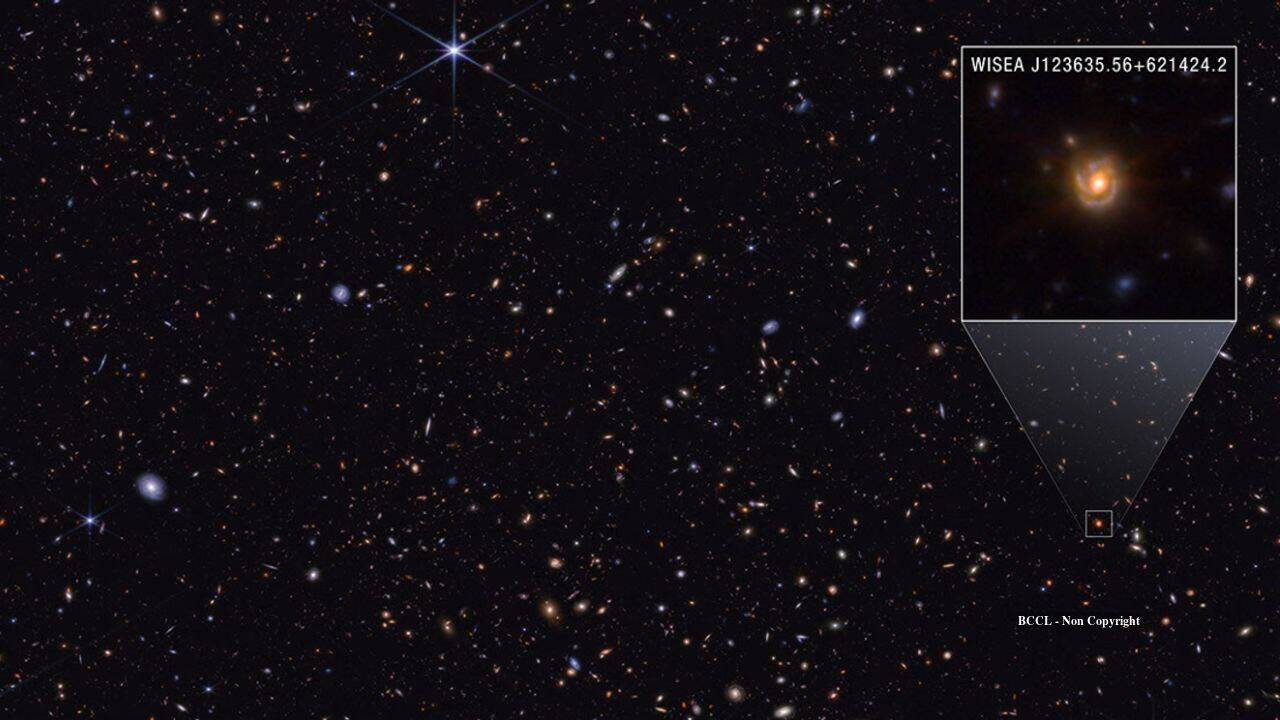
The James Webb Space Telescope has detected unusual bright red objects in its observations of the distant universe, a phenomenon that has perplexed astronomers since the instrument began operations. These mysterious celestial bodies, informally termed "little red dots" by researchers, have challenged existing models of galaxy formation and evolution.
The recent discovery of an ancient galaxy estimated to be 3.3 billion years old offers a potential explanation for these enigmatic observations. Scientists believe this galaxy's characteristics and composition may illuminate the nature of similar objects detected in Webb's deep-space surveys, helping to reconcile observations with theoretical predictions about how galaxies develop over cosmic time.
The findings underscore the James Webb Space Telescope's capability to observe extremely distant and ancient cosmic structures. By studying such discoveries, astronomers are gaining fresh insights into the universe's early history and the mechanisms governing galaxy formation across billions of years.
Researchers continue to analyze data from Webb's observations to better understand these red objects and their role in cosmic evolution. The identification of comparable ancient galaxies will help establish whether these mysterious sources represent a previously unknown class of celestial objects or variants of already-catalogued galaxy types.