World · Vietnam Bureau
Belgian physicist wins Nobel Prize for Antarctic ghost particle detection
Francis Halzen, a Belgian physicist who spent decades studying elusive subatomic particles beneath the South Pole ice, has been awarded the 2024 Nobel Prize in Physics. The recognition honors his groundbreaking work on neutrinos, fundamental particles that rarely interact with ordinary matter.
LSN Vietnam ·
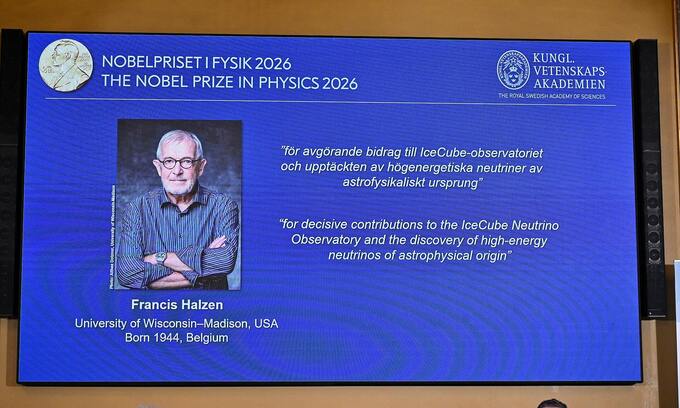
The Nobel Prize Committee announced Tuesday that Halzen received the prestigious award for his pioneering research on neutrinos, often referred to as "ghost particles" due to their ability to pass through matter virtually undetected. Halzen's decades-long investigation into these subatomic particles has fundamentally advanced scientific understanding of the cosmos and the nature of matter itself.
Halzen's work centered on the IceCube Neutrino Observatory, a massive detector buried deep within the Antarctic ice sheet at the South Pole. Since the 1980s, he has led efforts to construct and operate this facility, which captures rare interactions between neutrinos and ice molecules, allowing scientists to track these elusive particles arriving from distant cosmic sources including supernovae and active galactic nuclei.
The detection of neutrinos from space represents a breakthrough in astrophysics, opening a new window for observing the universe. Unlike traditional astronomy that relies on electromagnetic radiation, neutrino detection allows scientists to study cosmic phenomena that would otherwise remain invisible, providing crucial insights into the universe's most violent and energetic events.
The Nobel Prize recognition underscores the significance of neutrino physics in contemporary science. Halzen's contributions have established neutrino astronomy as a viable field of study, attracting researchers worldwide and inspiring new detector projects globally. His work demonstrates how persistent scientific inquiry, combined with innovative instrumentation, can unlock fundamental mysteries of nature and the cosmos.