World · India Bureau
CERN confirms quantum entanglement in extreme particle physics test
Scientists at Europe's Large Hadron Collider have gathered strong evidence for quantum entanglement among heavy Z bosons, validating one of quantum mechanics' most counterintuitive predictions in extreme energy conditions. The discovery marks a significant validation of quantum theory in environments far removed from everyday physics.
LSN India ·
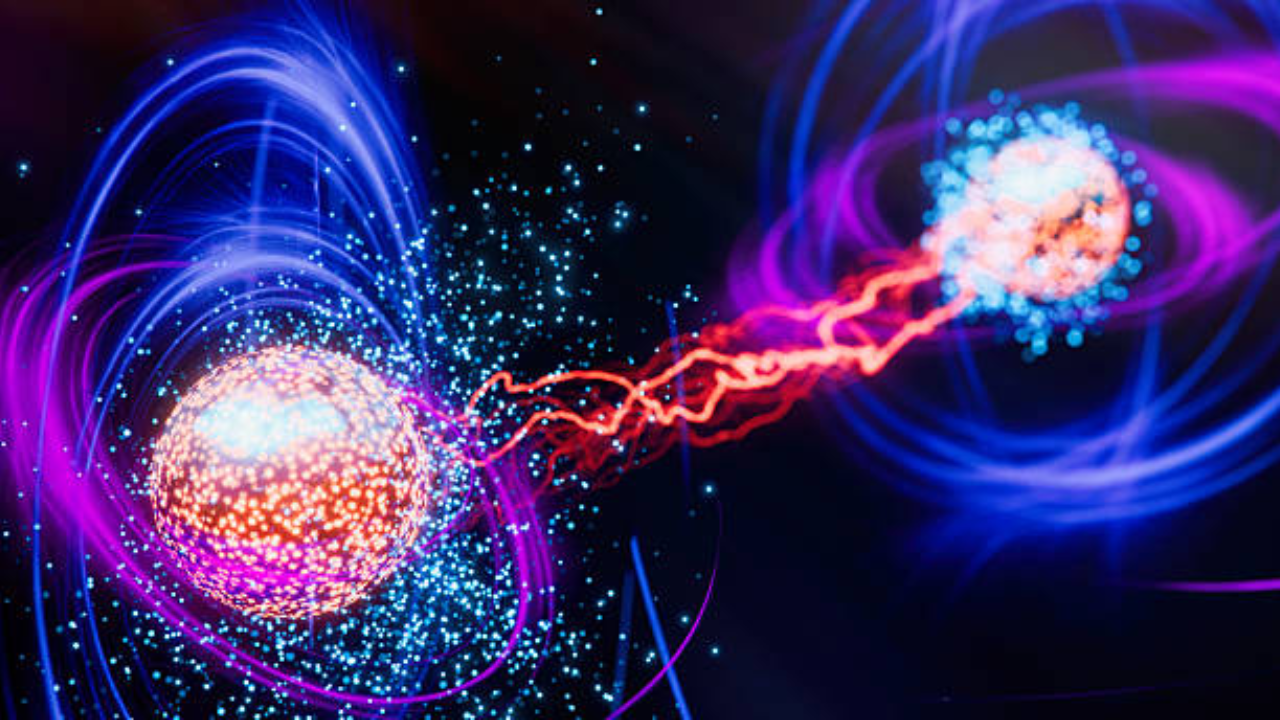
Researchers at CERN's facility near Geneva have detected quantum correlations between pairs of Z bosons—heavy subatomic particles that emerged from the decay of Higgs bosons during high-energy collisions. The finding provides compelling evidence that Einstein's so-called "spooky action at a distance," or quantum entanglement, persists even in the most extreme environments accessible to modern physics experiments.
Quantum entanglement describes a phenomenon where two particles become correlated in such a way that measuring one instantly influences the other, regardless of the distance between them. This concept has long troubled physicists, including Albert Einstein, who questioned whether it represented a fundamental feature of nature or an incomplete understanding of quantum mechanics.
The CERN team reconstructed the properties of the short-lived Z bosons by analyzing the particles produced when they decayed, a technically challenging process that required sophisticated data analysis methods. The strong quantum correlations observed in these heavy particles confirm that entanglement is not limited to laboratory conditions with simple systems, but operates across the full spectrum of particle interactions studied at the world's most powerful physics facility.
The research opens new avenues for investigating quantum phenomena at progressively higher energies, offering physicists a window into how quantum mechanics governs nature at its most fundamental level. Scientists plan to conduct additional experiments to probe entanglement effects with even greater precision in coming years.