World · India Bureau
Circular or square pillars: which structural design offers greater strength?
While square pillars remain the standard in residential construction across India, circular columns are increasingly visible in major infrastructure projects. Structural engineers weigh the comparative advantages of each design in different applications.
LSN India ·
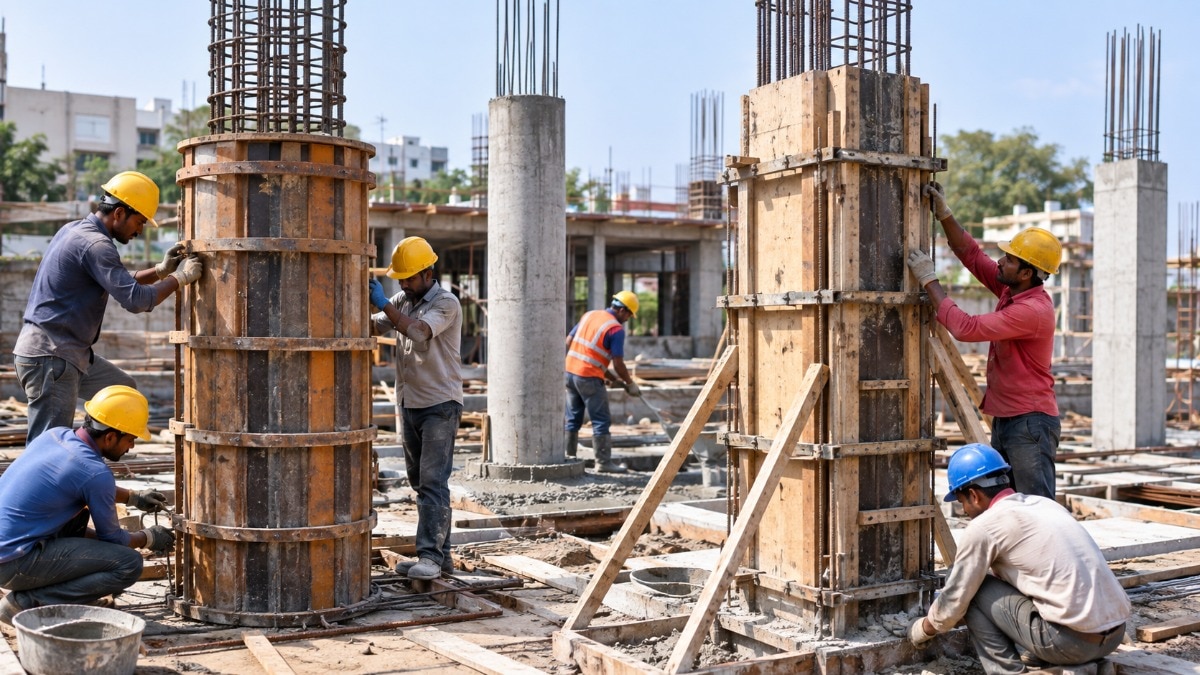
Square pillars have long dominated residential architecture in India, forming the foundation of countless homes and apartment buildings. Circular pillars, by contrast, are less common in domestic construction but appear regularly in large-scale infrastructure such as bridge supports, elevated highways, and commercial complexes.
The choice between circular and square pillar designs depends on multiple engineering factors beyond simple strength considerations. Circular pillars distribute loads more uniformly across their cross-section, potentially offering superior resistance to stress from multiple directions. This characteristic makes them particularly valuable in major infrastructure projects where dynamic forces and irregular loading patterns are common.
Square pillars offer distinct advantages in residential and commercial settings. Their flat surfaces facilitate easier connection to beams and slabs, simplify formwork during construction, and make more efficient use of floor space. The corners of square pillars can accommodate utilities and structural reinforcements more conveniently than curved surfaces.
Structural capacity depends not merely on shape but on several interconnected variables, including material quality, reinforcement design, soil conditions, and load specifications. Engineers select pillar geometry based on specific project requirements rather than adopting a universal standard. High-rise buildings and bridges typically employ circular designs to manage complex stress patterns, while residential construction favors square pillars for practical construction and spatial advantages.
Both pillar types, when properly designed and executed according to building codes, provide adequate structural integrity for their intended applications. The apparent prevalence of square pillars in homes reflects construction convenience and established building practices rather than superior inherent strength.