Cyclone Akvan: Sri Lanka's air quality worsens further, Chilaw hits 190 as Jaffna and other areas face health risk
Cyclone Akvan made landfall this morning across the north Andhra Pradesh and south Odisha coast near Gopalpur and is weakening as it moves inland; wind patterns may slowly return to normal as the storm moves away from the Indian coast, the weather authorities say.
LSN Sri Lanka ·
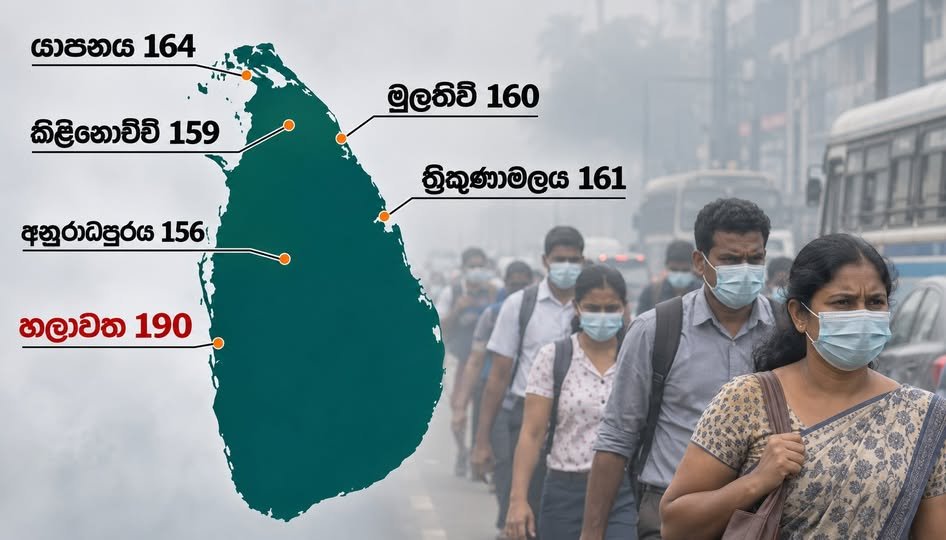
<p>Air quality in many parts of Sri Lanka remains at levels unhealthy to health because of changes in wind patterns caused by Cyclone "Akvan", which formed in the Bay of Bengal, the Central Environmental Authority (CEA), the Department of Meteorology and the National Building Research Organisation (NBRO) say.</p>
<p>Current situation (20 November 2026)</p>
<p>According to the latest Air Quality Index (AQI-SL) issued by the CEA at about 10.50am today (20 November), air quality in several parts of the island is at the "Unhealthy" level (151–200 range). The readings are:</p>
<p>Chilaw: 190 (the highest on the island)<br>
Jaffna: 164<br>
Trincomalee: 161<br>
Mullaitivu: 160<br>
Kilinochchi: 159<br>
Anuradhapura: 156</p>
<p>These levels can affect the health even of the general public. In addition, Mannar (132), Akkaraipattu (131), Battaramulla (131), Kandy (127), Ratnapura (126) and Ella (119) were recorded at the "slightly unhealthy" level (101–150 range).</p>
<p>Cyclone Akvan and cross-border dust from India</p>
<p>The Department of Meteorology and the CEA point out that the main cause is that Cyclone Akvan in the Bay of Bengal has turned wind currents blowing from the direction of India (from the north and north-west) towards Sri Lanka. These wind currents have carried suspended fine particles in the air across the border into the country.</p>
<p>Cyclone Akvan made landfall this morning (20 November) across the north Andhra Pradesh and south Odisha coastline (near Gopalpur) and is now weakening as it moves inland. The weather authorities say wind patterns may slowly return to normal as the storm moves away from the Indian coast.</p>
<p>What the authorities have observed</p>
<p>The CEA had reported a rise in fine particles in and around Jaffna, Kilinochchi, Mannar, Mullaitivu, Anuradhapura, Puttalam, Trincomalee, Colombo and Kurunegala since 16 November. On 18 and 19 November in particular, Jaffna's air quality index exceeded 200, reaching the "Very Unhealthy" level.</p>
<p>Commenting on this, Dr Ajith Gunawardena, Director of Environmental Education and Awareness at the CEA, said the situation could continue for another two to three days and that it is a normal pattern seen every year during the transition to the north-east monsoon.</p>
<p>The NBRO also stresses that although dust particles coming from the direction of India are the main cause, the situation has been made worse in urban areas such as Colombo by vehicle exhaust, factories and dust released by construction work.</p>
<p>Health advice issued to the public</p>
<p>In view of the situation, the CEA and the Ministry of Health have issued the following health advice:</p>
<p>- Children, the elderly and people with asthma, allergies or respiratory illnesses should make sure to wear N95 or KN95 masks.<br>
- Avoid staying outdoors for long periods or doing strenuous exercise.<br>
- Keep doors and windows of homes closed as needed.<br>
- Seek medical advice immediately if breathing difficulties or other symptoms appear.</p>
<p>Air quality is expected to improve gradually over the next few days as the storm moves away from the Indian coast. The authorities urge the public to check the latest air quality data and full health advice regularly on the CEA's official website, aq.cea.lk.</p>
<p>Translated from the LSN Sinhala edition.</p>