Business · Bangladesh Bureau
Gulf migration transforms Bangladesh beyond economics, reshaping society
Decades of labor migration to the Gulf has fundamentally altered power dynamics, religious practice, and gender relations in Bangladesh, extending far beyond the financial remittances that sustain millions of households.
LSN Bangladesh ·
The mass exodus of Bangladeshi workers to Gulf states since the 1970s has triggered profound social transformations that penetrate deep into the nation's cultural and political fabric. While remittances remain a critical economic lifeline, accounting for a substantial portion of foreign exchange earnings, the phenomenon has simultaneously reshaped family structures, community hierarchies, and religious expression across the country.
The extended absence of male breadwinners has shifted traditional gender dynamics, granting women greater decision-making authority within households and communities. Women left behind have increasingly assumed roles in agriculture, small business, and local governance, challenging longstanding patriarchal norms. Simultaneously, the wealth accumulated through Gulf employment has created new class divisions and altered local power hierarchies, as returnee migrants wield enhanced influence in their communities and in politics.
Religious practices have also undergone significant change, with returning migrants often bringing interpretations of Islam influenced by Gulf nations. This has contributed to shifts in how Islam is practiced and understood in Bangladesh, influencing everything from mosque attendance patterns to dress codes and family rituals. The influx of Gulf-influenced religious perspectives has sometimes intensified religious conservatism while also introducing new theological interpretations that differ from traditional Bengali Islamic practice.
As the Gulf migration phenomenon matures into its fifth decade, policymakers and researchers increasingly recognize that understanding its full impact requires looking beyond economic metrics to examine how labor mobility has fundamentally reconfigured Bangladeshi society across multiple dimensions.
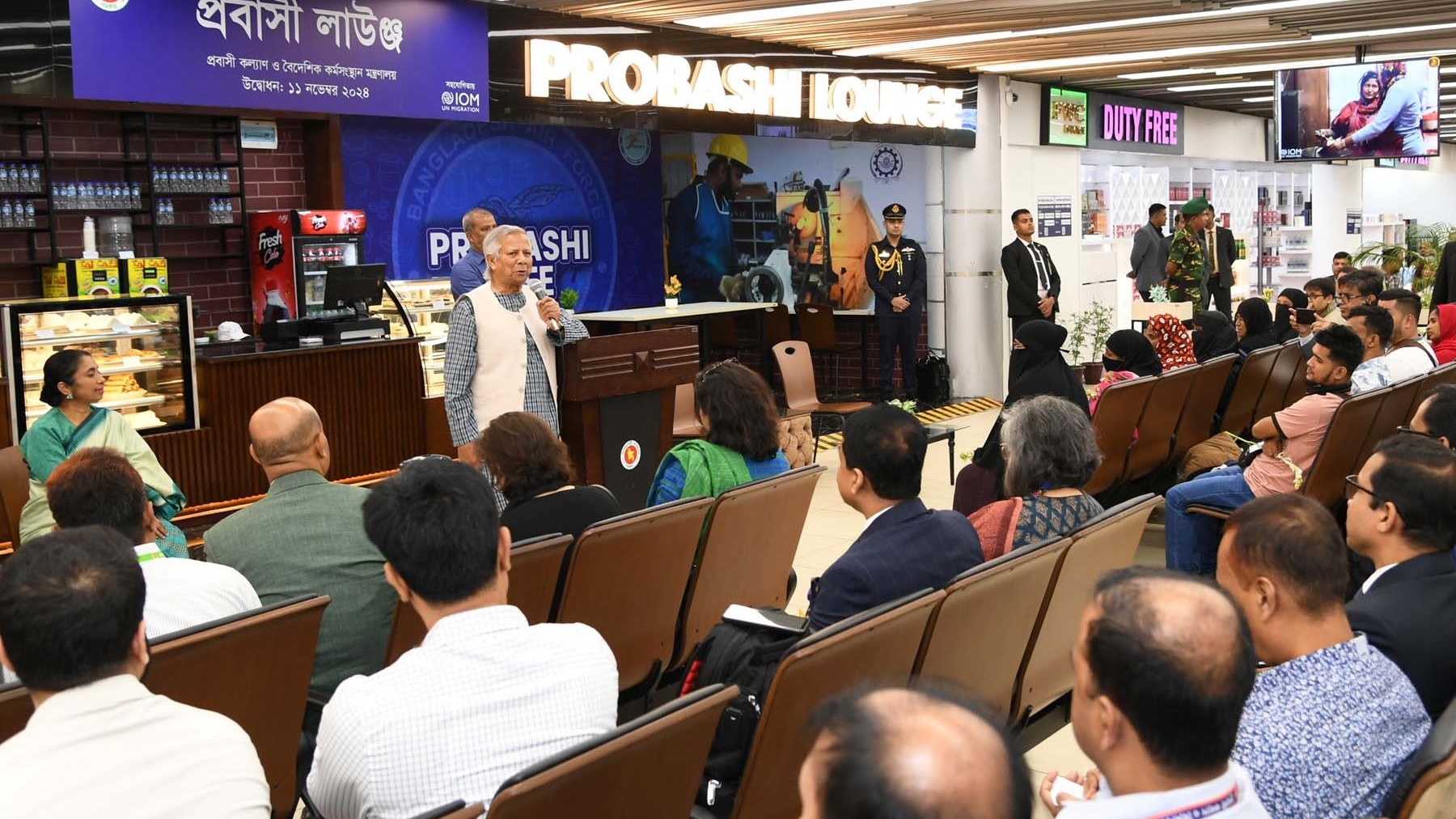
Photo: The Probashi Lounge for migrant workers at Hazrat Shahjalal International Airport, Dhaka, on its opening day, November 2024. Press Information Department, Government of Bangladesh, via Wikimedia Commons (public domain).