Have the dark shadows of the past also fallen on the “Ratama Ekata” operation that netted more than 300,000 suspects?
Although 321,072 suspects were arrested in the national “Ratama Ekata” operation, police had been acting to catch drug users rather than traffickers in order to show the numbers. Because of that biased conduct, the Inspector General has decided to limit the Rs 5,000 reward given for drug raids to raids of more than two grams only.
LSN Sri Lanka ·
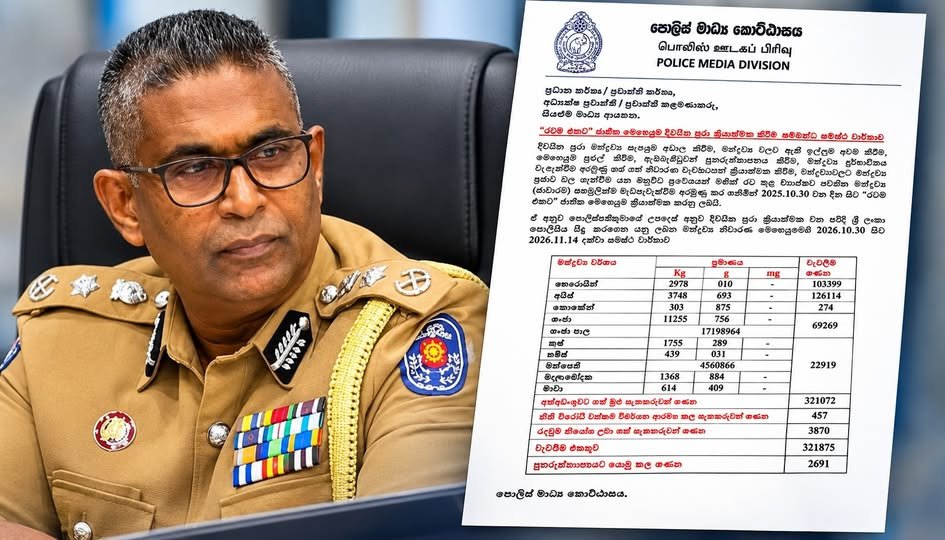
<p>An extremely large quantity of drugs, of a scale never seen before in this country’s history, has been seized after the present government came to power. The highest number of arrests connected with drugs is also being recorded in this period. From the police report issued today, it appears that even the “Yukthiya” operation carried out during the previous Ranil Wickremesinghe administration by Tiran Alles and Deshabandu Tennakoon could not come anywhere near the numerical progress the present national “Ratama Ekata” operation has achieved.</p>
<p>The Ratama Ekata national movement was begun with a broad vision. Its aspiration is to fully suppress the drug trade through several approaches: disrupting supply across the island, reducing demand, expanding operations, rehabilitating people with addictions, running prevention programmes and empowering communities. The report with statistical data showing the physical reality of those targeted aims was issued today on the Inspector General’s instructions. It compiled an overall summary of operations carried out over a period of more than a year, from 30 October 2025 to 14 November 2026.</p>
<p>Record figures and drugs taken into police custody</p>
<p>According to the report issued by the Police Media Division, the total number of raids carried out across the island in the relevant period was 321,875, and the total number of suspects arrested was 321,072. Of these, detention orders have been obtained for 3,870 suspects for further investigation, and inquiries have been opened against 457 suspects over the earning of illicit assets. In addition, 2,691 people with addictions have been referred for rehabilitation.</p>
<p>Quantities taken into police custody from 30 October 2025 to 14 November 2026, and the related raids, were as follows:</p>
<p>Ice: 3,748 kilograms and 693 grams (126,114 raids)</p>
<p>Heroin: 2,978 kilograms and 10 grams (103,399 raids)</p>
<p>Cannabis: 11,255 kilograms and 756 grams, and 17,198,964 cannabis plants (69,269 raids)</p>
<p>Cocaine: 303 kilograms and 875 grams (274 raids)</p>
<p>Kush: 1,755 kilograms and 289 grams</p>
<p>Hashish: 439 kilograms and 31 grams</p>
<p>Narcotic pills: 4,560,866 pills (22,919 raids)</p>
<p>Madanamodaka: 1,368 kilograms and 884 grams</p>
<p>Mawa: 614 kilograms and 409 grams</p>
<p>The internal crisis behind the statistics, and unjust raids</p>
<p>However, a serious and problematic situation has also been created behind this enormous numerical success. It has not been possible to prevent the unjust conduct that occurred at the hands of some police officers during the previous “Yukthiya” operation from occurring in the same way in the “Ratama Ekata” operation as well. It was against that background that strong criticisms were directed at the Inspector General from the Gampaha Magistrate’s Court, going as far as an allegation of contempt of court.</p>
<p>Although the Inspector General, through Zoom discussions, instructed officers until his voice broke not to arrest innocent people without reason and not to portray even an ordinary drug user as a large-scale trafficker, a situation has arisen in which it has not been possible to bring onto the proper path some officers who, hiding behind justice, allow injustice to reign — and this, it is said, has become all too clear to the Inspector General himself. The final, severe criticism is now being directed at the Inspector General personally.</p>
<p>An internal police investigation has revealed that, among the more than 300,000 people said to have been arrested, the same person has been arrested three or four times and the statistical data have been inflated.</p>
<p>Revision of rewards and calling in the Special Bureau</p>
<p>The Inspector General had previously taken steps to give a reward of Rs 5,000 per raid to encourage police officers for drug raids. But a main reason for this problem has been that, targeting that reward, some officers showed a strong interest in arresting drug users who take a packet for the day’s need, instead of catching large-scale traffickers.</p>
<p>Taking this situation into account, the Inspector General has now arrived at several firm decisions:</p>
<p>1. Quantity over numbers: it has been decided to give priority to the quantity of drugs seized, rather than showing the number of raids.</p>
<p>2. Limiting rewards: orders have been given that the Rs 5,000 reward will from now on be given only for drug raids of more than two grams.</p>
<p>3. Intelligence inquiries and disciplinary action: the Special Bureau, the intelligence arm under the Inspector General, has been deployed to look into police officers who arrest people without drugs and falsely plant drugs to imprison innocent people.</p>
<p>As a result of investigations carried out on that basis, the Inspector General has already taken firm disciplinary action against several officers at the Maligawatta, Maaravila and Hungama police stations.</p>
<p>The Inspector General has in this way taken a firm position in order to prevent the public displeasure that could fall on the government and the Police Department because of these unjust police actions.</p>
<p>It should be recorded, the article says, that this programme launched in relation to police thugs who abuse the responsible freedom given to them to do their duty is beneficial for the country, even if it has begun late.</p>
<p>Translated from the LSN Sinhala edition.</p>