Il Full Moon Poya: the historic Buddhist events linked to the day
The last Poya of the rainy season and of the robe-offering month marks Maitreya's assurance of Buddhahood, the first Dhamma mission, Sariputta's passing and the start of Sri Lanka's first stupa.
LSN Sri Lanka ·
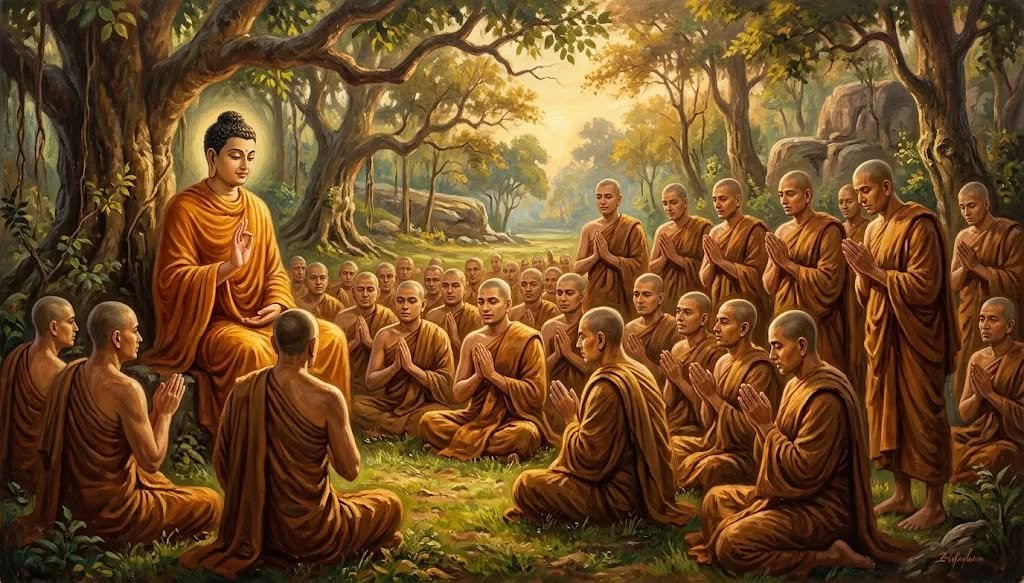
<p>Il Full Moon Poya Day, the last Poya of the rainy season and the final Poya of the Cheevara (robe-offering) month, is a sacred day tied to a series of memorable events in the history of the Buddha Sasana.</p>
<p>According to Buddhist literature, they include the definite prediction that the Bodhisattva Maitreya would become a Buddha; the sending out of the first 60 arahant missionaries to spread the Dhamma; the Buddha's journey to Uruvela to convert the three Jatila brothers; the day on which monks who began the later rains retreat conclude it with the Pavarana ceremony; the last day on which the Kathina robe ceremony may be held; the passing away (parinibbana) of the Chief Disciple Sariputta; and the advice that led to the bringing of the Buddha's right collarbone relic to Sri Lanka for the Thuparama, the island's first stupa.</p>
<p>Maitreya receives the assurance of Buddhahood</p>
<p>Moved by the great festival of the Buddha's descent from the deva world and by a question-and-answer discussion between the Buddha and Sariputta, the Bodhisattva Maitreya came to the Buddha on Vap Poya with a retinue of about a thousand and was ordained. In the Buddha Gotama's time he had been born in Sankassa, about three yojanas from Savatthi, as the son of a wealthy householder named Sirivaddha. Educated by a renowned teacher and heir to the family fortune on his parents' death, he gave up lay life after witnessing the Buddha's miracles and, once ordained, studied the Dhamma and taught it to other monks.</p>
<p>At the end of a later robe month he received a pair of costly cloths. Knowing the merit of robe offerings, he tied one as a canopy in the Buddha's Gandhakuti and tore the other to decorate the canopy's edges, offering it to the Buddha before sitting to one side among the Sangha.</p>
<p>Seeing this, the Buddha declared that the monk would become a Buddha named Maitreya in this same Bhadda Kappa. Addressing the Sangha, he said (translated): "Monks, look at this monk who has honoured the Buddha with a pair of costly cloths. He will become the Fully Enlightened One Maitreya in this great Bhadda Kappa. Then there will be a capital named Ketumati at Baranasi, with a universal monarch named Sankha. His chaplain, the brahmin Brahma, will be Maitreya Buddha's father, and the chaplain's wife, Brahmavati, his mother. A naa tree will be his Bodhi tree."</p>
<p>Buddhist literature records that the Sangha cheered, the gods offered heavenly flowers and people celebrated, and that this took place on an Il Poya day.</p>
<p>The first Dhamma mission</p>
<p>After spending his first rains retreat at Isipatana in Baranasi, the Buddha concluded the retreat and, out of compassion for the world, sent out the first 60 arahant missionaries on an Il Poya day. He instructed them (translated): "Go forth, monks, for the welfare and happiness of the many, out of compassion for the world, for the good, welfare and happiness of gods and humans. Let no two of you go the same way. Teach the Dhamma that is good in the beginning, good in the middle and good at the end, complete in meaning and expression, and proclaim the holy life that is wholly pure."</p>
<p>Journey to Uruvela to convert the Jatila brothers</p>
<p>Having sent out the missionaries, the Buddha travelled on an Il Poya day to Uruvela, where three ascetic brothers lived in hermitages near the Neranjara river: Uruvela Kassapa with 500 followers, Nadi Kassapa with 300 and Gaya Kassapa with 200. At the eldest brother's hermitage the Buddha is said to have performed 3,516 miracles, winning over Uruvela Kassapa and his 500 followers, who were ordained and cast their matted locks and ascetic belongings into the river.</p>
<p>Seeing the belongings floating downstream, Nadi Kassapa came to check whether his brother had come to harm, and on finding them ordained he too was ordained with his 300 followers. Gaya Kassapa followed with his 200. Soon afterwards the Buddha took these thousand former ascetics to Gayasisa, where he preached the Adittapariyaya Sutta (the Fire Sermon) and all attained arahantship.</p>
<p>The later Pavarana and the end of the robe month</p>
<p>The Pavarana ceremony that monks must hold after the rains retreat takes two forms. Monks who begin the first retreat the day after Esala Poya conclude it on Vap Poya, while those who begin the later retreat the day after Nikini Poya conclude it on Il Poya. The Buddha's rule, quoted in Pali in the source, permits monks who have completed the retreat to invite admonition on three grounds: what has been seen, heard or suspected.</p>
<p>Pavarana is compulsory for monks who have observed the retreat, and neglecting it breaches a rule laid down by the Buddha. It takes nine forms: three by day (Catuddasi, Pannarasi and Samaggi), three by participants (Sangha, group and individual) and three by the manner of recitation. A Sangha Pavarana needs at least five monks and is held within the 29 days from the day after Vap Poya to Il Poya.</p>
<p>The robe month that begins on Vap Poya also ends on Il Poya, making it the last day on which Kathina robe-offering ceremonies can be held. Though rich in religious significance, the month of Il is also regarded in Sri Lanka as a time of heavy rain, floods and landslides.</p>
<p>The passing of Chief Disciple Sariputta</p>
<p>In his 45th year the Buddha spent the rains at Beluva village and, after the Pavarana, went to the Jetavana monastery at Savatthi. Knowing that chief disciples pass away before the Buddha, Sariputta examined his own lifespan and found he had only seven days left. He decided to go to the house where he was born to bring his mother, Rupasari, who had not yet found faith in the Triple Gem, to the path.</p>
<p>Approaching the Buddha with 500 monks, he said (translated): "Venerable Sir, I am now old. There is no returning here. This is my last journey and my last salutation. My life is short. Like one who sets down a burden, seven days from now I will lay down this body. May the Blessed One permit me. This is the time of my parinibbana."</p>
<p>Announcing that he would pass away in the room where he was born in the village of Nalaka in Magadha, he displayed psychic powers, preached, and took his final leave of the Buddha, saying that the wish to see a Buddha he had made at the feet of the Buddha Anomadassi had been fulfilled.</p>
<p>After seven days of travel, helping people he met along the way, he reached Nalaka on the evening of Il Poya. He sent word to his mother through his nephew, the brahmin Uparevata, had his birth room prepared, and from there preached to her on the Buddha's virtues. At the end of the sermon Rupasari attained the first stage of awakening (Sotapanna). Content that he had repaid his debt to his mother for raising him, Sariputta passed away as the earth trembled. The Buddha later had his relics enshrined in a stupa.</p>
<p>Where the Buddha spent the rains</p>
<p>In the first 20 years after his enlightenment the Buddha did not stay in one place for the rains but chose different locations according to circumstances:</p>
<p>1st: Isipatana, Baranasi<br>
2nd, 3rd and 4th: Veluvanarama, Rajagaha<br>
5th: Kutagara Hall, Vesali<br>
6th: Mankula mountain<br>
7th: Tavatimsa heaven<br>
8th: Bhesakala grove near Sumsumaragiri, Bhagga country<br>
9th: Ghositarama, Kosambi<br>
10th: Parileyya forest<br>
11th: Ekanala brahmin village<br>
12th: Veranja<br>
13th, 18th and 19th: Caliya mountain<br>
14th: Jetavana, Savatthi<br>
15th: Nigrodharama, Kapilavatthu<br>
16th: Alavi<br>
17th and 20th: Veluvanarama, Rajagaha</p>
<p>Of the remaining 25 years, he spent 19 at Jetavana and six at Pubbarama, both in Savatthi, spending all 25 there in recognition of the devotion of Anathapindika and the great lay devotee Visakha.</p>
<p>Building the Thuparama and bringing the right collarbone relic</p>
<p>The Arahant Mahinda's mission and Sinhala arahants including Arittha, the first Sinhala monk, numbering 60 in all, spent the rains retreat in the 68 caves of Mihintale at King Devanampiyatissa's invitation.</p>
<p>After the Pavarana on Vap Poya, it was on an Il Poya day that Mahinda advised the king that a stupa enshrining the Buddha's relics should be built so that the people of Lanka had a place of worship.</p>
<p>The novice Sumana then travelled to India and brought back a bowlful of relics received from Emperor Dharmasoka and the Buddha's right collarbone relic received from Sakra, king of the gods. The bowl relics were enshrined at Mihintale, while the right collarbone relic was taken to Anuradhapura, where King Devanampiyatissa built the Thuparama Chaitya to enshrine it. The Thuparama was the first stupa built in Sri Lanka after the Buddha Sasana was established on the island.</p>
<p>Translated from the LSN Sinhala edition.</p>