Politics · World News Bureau
Japan's nuclear taboo: Tokyo tests the line
Japan's defence minister has renewed calls to debate the Three Non-Nuclear Principles and nuclear-powered submarines as Tokyo rewrites its security documents, while China and Russia pledge deeper military ties.
LSN World News ·
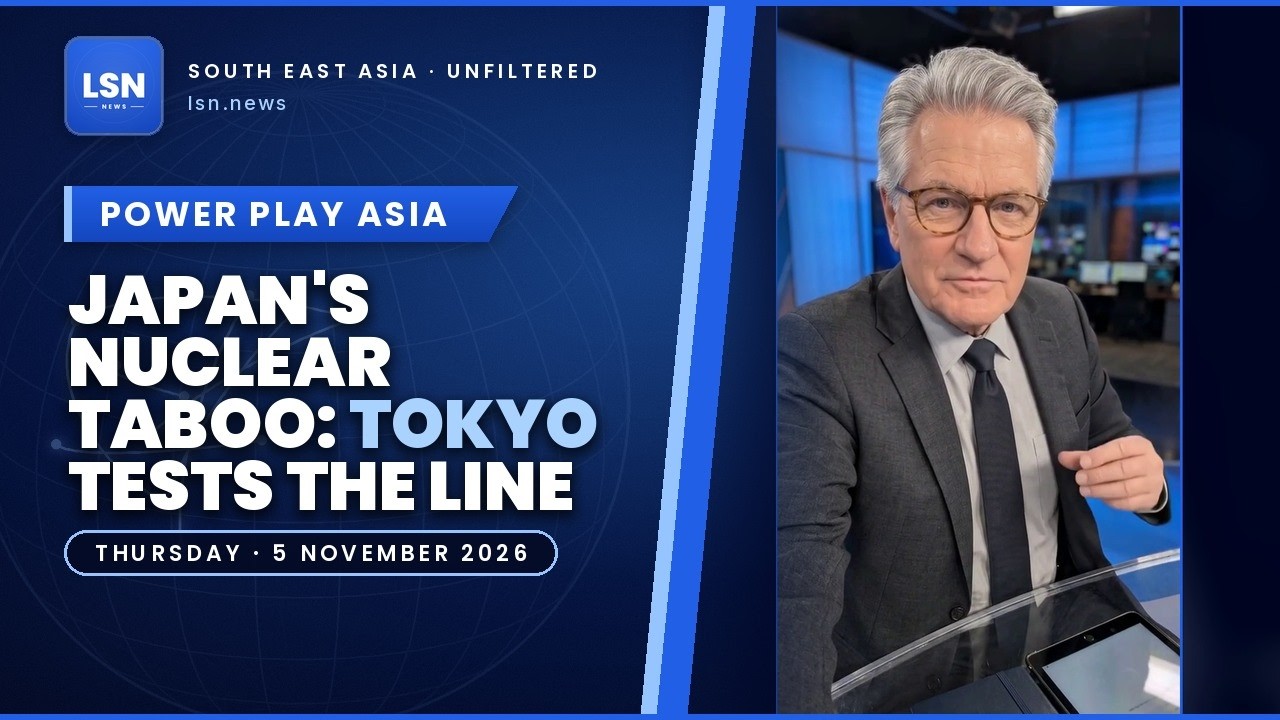
<p><em>Special Reporting from LSN News, adapted from today's Power Play Asia episode. <a href="https://youtu.be/8zJDdONTr3E" target="_blank" rel="noopener">Watch the video on YouTube.</a></em></p>
<p>On Tuesday in Tokyo, Japan's defence minister reopened one of the country's oldest taboos. Shinjiro Koizumi called again for an open debate on Japan's Three Non-Nuclear Principles and backed a debate on nuclear-powered submarines. On the same day in Beijing, China's most senior uniformed general sat down with Russia's defence minister and promised deeper military ties. The question for Asia is whether Japan is breaking a taboo, or whether the neighbourhood is breaking it for Japan.</p>
<h2>A taboo up for revision</h2>
<p>Japan has long said it will not possess, produce or permit the introduction of nuclear weapons, and its current National Security Strategy says that policy will remain unchanged. But that strategy is being rewritten, with Japan's three key security documents due for revision by the end of this year.</p>
<p>Speaking at a seminar in Tokyo, Koizumi pointed to Chinese and Russian military activity around Japan, Kyodo News reported. He said Japan must create an environment in which necessary security policies can be discussed openly and frankly, and that society as a whole should share an understanding of the nuclear threat. "Even with the various constraints, I hope we can at this stage make the revisions that best reflect the realities of the situation," he said, as quoted by the Global Times from Kyodo. Japanese media have reported that the government of Prime Minister Sanae Takaichi may revise the wording on the principles in that update.</p>
<p>In LSN's reading, no one in Tokyo is proposing a Japanese bomb. The target is narrower: the rule against letting nuclear weapons in. That clause matters for American deterrence on Japanese soil.</p>
<h2>The submarine question</h2>
<p>In October, Takaichi told parliament her government would "seriously consider" nuclear-powered submarines "in a concrete and realistic manner," Kyodo reported. The Asahi Shimbun, citing government and coalition sources, reports that the leading option is not a decision to buy, but a line committing Japan to start studying next-generation power sources, including nuclear power, for missile-carrying submarines.</p>
<p>The hurdles are real. According to Asahi, a nuclear submarine is said to cost about one trillion yen to build, at least three would be needed to keep one ready at all times, and the whole process is believed to take more than a decade. One source close to Japan's navy told the paper: "We do not have the manpower to spare for nuclear submarines." A senior figure on the ruling party's security panel put it this way: "While debate itself is not taboo, taking it any further beyond that might well be."</p>
<p>Yet the region is moving. Asahi notes that Washington approved South Korea's construction of nuclear submarines last year, and Australia is moving ahead with its own plans.</p>
<h2>The neighbours make Tokyo's case</h2>
<p>In Beijing on Tuesday, General Zhang Shengmin, vice chairman of China's Central Military Commission, met Russian defence minister Andrei Belousov. Zhang pledged deeper strategic communication and military cooperation, China Daily reported. Belousov said the security situation in the Asia-Pacific was complex and volatile and, according to the Global Times as cited by Anadolu, called the partnership "unprecedentedly high." Those are the two militaries Koizumi points to.</p>
<p>Beijing's response to Tokyo came through its press. The Global Times called Koizumi's argument a pretext and quoted Lian Degui of Shanghai International Studies University, who said Japan is gradually eroding the bottom line of its post-war nuclear policy. Chinese state media also reported that nearly ten thousand protesters gathered outside Japan's parliament last Friday, opposing the government's nuclear and defence plans.</p>
<p>In Washington, Democrats have taken both houses of Congress. Japan's chief cabinet secretary, Minoru Kihara, said Tokyo would work with Washington "to elevate the Japan-U.S. alliance to new heights." Adrian Ang of the S Rajaratnam School of International Studies told CNA that a Democratic Congress could be "more hawkish" on China than Trump himself.</p>
<p>On LSN's scorecard, Tokyo's direction is moving, one careful word at a time. Japan's home front is divided, with protests, costs and a manpower shortage. Beijing and Moscow are closing ranks, and in doing so writing Tokyo's case for it. Washington is reassuring in words, with a new Congress still to show its hand.</p>
<p>Our verdict: Japan is not racing to the bomb; it is dismantling the taboo around talking about one. Every Chinese and Russian manoeuvre near Japan makes that debate easier to win at home. The test is the year-end documents. If the non-nuclear wording changes, it will be one of the biggest shifts in Japan's security posture in decades, and every capital from Beijing to Seoul will recalculate.</p>
<h2>Sources</h2>
<ul>
<li><a href="https://english.news.cn/20261103/a4ea44fb9f69467e92546a6092632a73/c.html" target="_blank" rel="noopener">Xinhua (citing Kyodo), 3 Nov 2026, "Japan defense chief renews calls for debate on reviewing non-nuclear principles"</a></li>
<li><a href="https://www.thestar.com.my/aseanplus/2026/11/04/japan-defence-chief-renews-calls-for-debate-on-reviewing-non-nuclear-principles" target="_blank" rel="noopener">The Star (Malaysia), 4 Nov 2026, "Japan defence chief renews calls for debate on reviewing non-nuclear principles"</a></li>
<li><a href="https://www.nikkei.com/article/DGXZQOUA032EF0T01C26A1000000/" target="_blank" rel="noopener">Nikkei (Kyodo), 3 Nov 2026, "小泉防衛相、非核三原則巡り「議論の環境づくり重要」"</a></li>
<li><a href="https://www.globaltimes.cn/page/202611/1373643.shtml" target="_blank" rel="noopener">Global Times (Li Yawei), 4 Nov 2026, "Koizumi uses China, Russia as pretext to adjust nuclear policy, expert dismisses claim as recycled rhetoric"</a></li>
<li><a href="https://english.kyodonews.net/articles/-/88192" target="_blank" rel="noopener">Kyodo News, 14 Oct 2026, "Japan PM says to "seriously consider" introduction of nuclear subs"</a></li>
<li><a href="https://www.asahi.com/ajw/articles/16959996" target="_blank" rel="noopener">The Asahi Shimbun (Mizuki Sato, Anri Takahashi), 13 Oct 2026, "Japan could add study on nuclear subs in security policy update"</a></li>
<li><a href="https://www.scmp.com/news/china/military/article/3373176/top-chinese-general-meets-russian-defence-minister-days-after-politburo-appointment" target="_blank" rel="noopener">South China Morning Post, 3 Nov 2026, "Top Chinese general meets Russian defence minister days after Politburo appointment"</a></li>
<li><a href="https://www.chinadaily.com.cn/a/202611/03/WS6ae9c13ae4b06d4aa0566d0e.html" target="_blank" rel="noopener">China Daily (Zhao Lei), 3 Nov 2026, "China and Russia pledge enhanced military cooperation to bolster global and regional stability"</a></li>
<li><a href="https://www.aa.com.tr/en/world/china-russia-vow-to-deepen-military-ties-as-top-defense-officials-meet-in-beijing/4109964" target="_blank" rel="noopener">Anadolu Agency (Aamir Latif), 3 Nov 2026, "China, Russia vow to deepen military ties as top defense officials meet in Beijing"</a></li>
<li><a href="https://english.kyodonews.net/articles/-/90393" target="_blank" rel="noopener">Kyodo News Digest, 5 Nov 2026, "U.S. midterm results not to affect strength of alliance: Japan gov't"</a></li>
<li><a href="https://www.channelnewsasia.com/asia/us-democrats-midterm-results-asia-impact-china-6523456" target="_blank" rel="noopener">CNA, 5 Nov 2026, "US midterms: Democrats' victory puts Trump's China diplomacy to the test"</a></li>
</ul>