Magnitude 6.4 earthquake strikes southern Indian Ocean; no tsunami threat to Sri Lanka
The quake hit near Mauritius and Réunion far from populated land, and Sri Lanka's National Tsunami Early Warning Centre says the island's coastal areas are completely safe.
LSN Sri Lanka ·
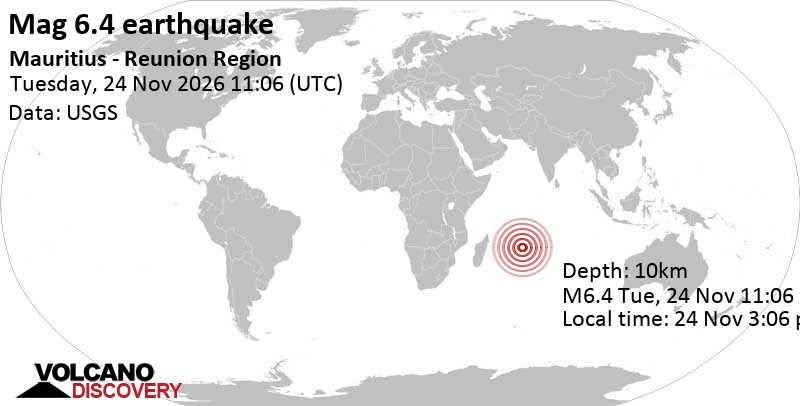
<p>An earthquake of magnitude 6.4 struck the southern Indian Ocean today (Tuesday, 24 November 2026), in the region around the islands of Mauritius and Réunion.</p>
<p>However, Sri Lanka's National Tsunami Early Warning Centre has announced that the quake poses no impact or tsunami risk to Sri Lanka, and that the island's coastal areas are completely safe.</p>
<p>According to the United States Geological Survey (USGS), the quake struck at about 11:06 am Coordinated Universal Time (UTC). Its epicentre was on the seabed at a depth of 10 km, at 17.705 degrees south and 65.700 degrees east, about 300 km northeast of Rodrigues Island, which belongs to Mauritius.</p>
<p>The area is part of the open southern Indian Ocean east of Madagascar. Initial reports put the quake's magnitude at between 6.0 and 6.5, but after later technical reviews it was confirmed as 6.4.</p>
<p>Notably, the quake struck in a deep-sea zone far from populated land. The USGS impact assessment system (PAGER) classified the event as "Green", which means it is not likely to cause any significant damage to property or loss of life. No tsunami waves have been reported as a result of the quake so far.</p>
<p>After closely checking local and international scientific data systems, the National Tsunami Early Warning Centre confirmed that there is no tsunami threat to Sri Lanka. Authorities say people living in the island's coastal areas can therefore go about their normal daily activities without any fear. The centre issued similar no-threat notices after other earthquakes in the Indian Ocean region in the first half of November 2026.</p>
<p>Indian Ocean monitoring agencies, including bodies affiliated with India's Indian National Centre for Ocean Information Services (INCOIS), regularly exchange data on such geological events. International bodies such as the USGS and the European-Mediterranean Seismological Centre (EMSC) also monitored the quake closely.</p>
<p>Experts point out that there was no need to issue a special warning for the island because the epicentre lay thousands of kilometres from Sri Lanka, and the quake was not strong enough to cause a tsunami from such a distant location.</p>
<p>Authorities remain alert to whether aftershocks occur in the area, and have further confirmed that there has so far been no change in the safe status of Sri Lanka's coastline.</p>
<p>Translated from the LSN Sinhala edition.</p>