World · India Bureau
NASA's 1984 Honeybee Mission Explored Construction in Microgravity
Four decades ago, the U.S. space agency conducted a unique experiment by sending thousands of honeybees into orbit to observe how they would build honeycomb without the influence of Earth's gravity.
LSN India ·
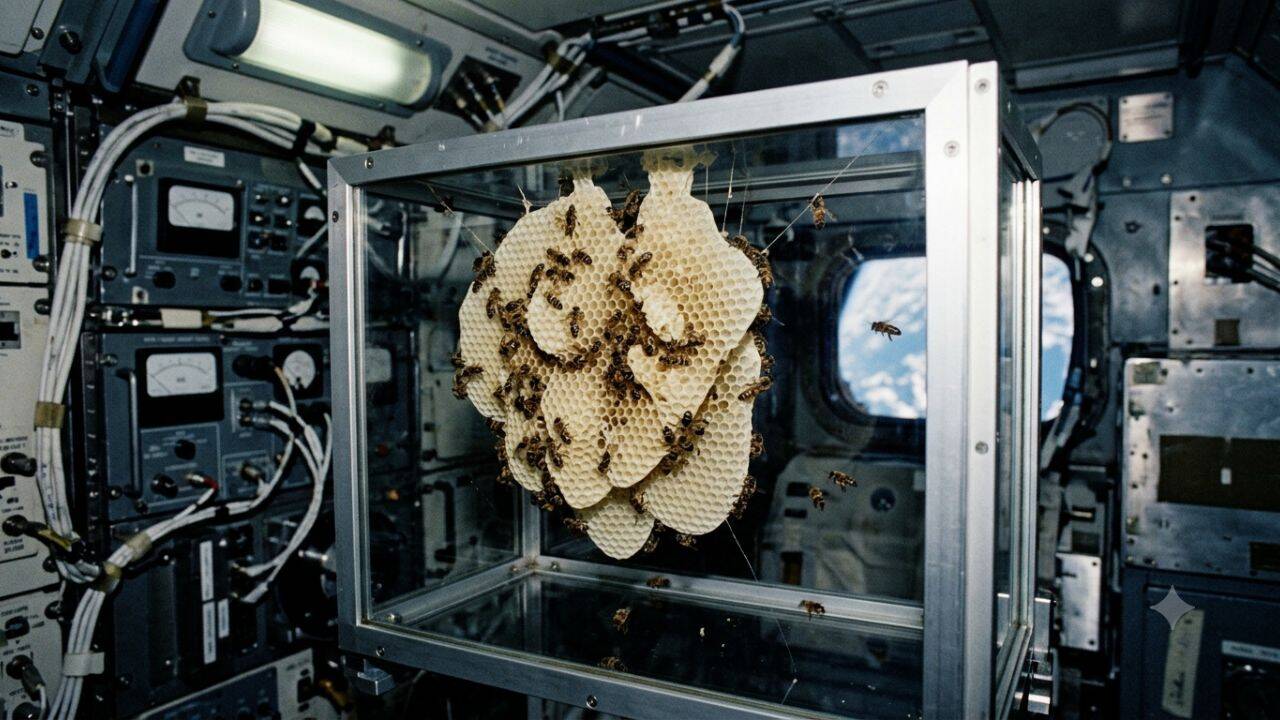
In 1984, NASA conducted an unusual scientific experiment that sent thousands of honeybees into space aboard a Space Shuttle mission. The objective was to study how these insects would construct honeycomb in the absence of gravitational forces—a phenomenon that had never been directly observed before.
Honeybees rely heavily on gravity in their natural environment to build their hexagonal honeycomb structures vertically within hives. The experiment was designed to determine whether bees could adapt their construction methods when gravity was removed, and whether their instinctive building patterns would be altered in microgravity conditions.
The mission represented a creative approach to understanding animal behavior and adaptation in space environments. Scientists hoped the findings would provide insights into how living organisms function when traditional physical constraints are eliminated, potentially informing future long-duration space missions involving biological systems.
While space-based biological research has primarily focused on human physiology and plant growth, this honeybee mission stood out as a distinctive venture into studying insect behavior beyond Earth. The experiment contributed to NASA's broader understanding of how life adapts to the unique conditions of orbital spaceflight, adding to the agency's body of knowledge about biological responses to microgravity.