Opinion: As universities join the strike wave tomorrow, the union campaign heating up the public service puts pressure on the Budget
Speaking up against the loss of benefits workers once had, and demanding that salary anomalies be fixed, is fair as a matter of workers' rights. But the authorities' failure to engage the unions within a democratic framework has let the situation flare into a political wildfire.
LSN Sri Lanka ·
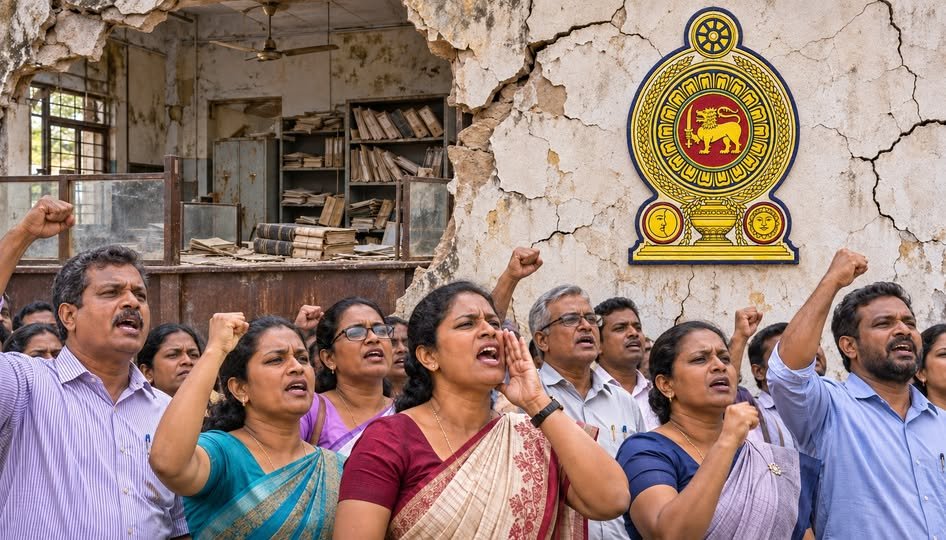
<p>The Joint Committee of University Trade Unions has decided to stage a one-day token strike on 25 November and an island-wide token strike on 1 and 2 December, in protest at what it says is the failure of the government and the University Grants Commission (UGC) to respond properly to its demands.</p>
<p>With this, the non-academic staff of the university system have now joined a series of trade union actions against the 2027 Budget proposals that has spread across the entire public service, including teachers, principals and health workers.</p>
<p>Main demands of university non-academic staff</p>
<p>In a letter dated 16 November, the joint committee told the UGC that neither the government nor the relevant authorities had so far responded to the issues raised in its earlier letters, nor even granted an official meeting. The committee therefore decided unanimously to continue its trade union action over the coming weeks. It expressed regret for the inconvenience to university students, but stressed that full responsibility for resolving the problems lies with the authorities.</p>
<p>The unions, led by university non-academic staff, are demanding the restoration of the salaries, overtime payments and other allowances that were cut under the 2025 Budget.</p>
<p>Committee co-chairman Mangala Dabarera said (translated): "At no point are we asking for a new salary increase. What we are asking is that the salaries, allowances and overtime payments cut from us in the 2025 Budget be given back. This government has not held talks with any trade union group that has gone on strike or taken other trade union action."</p>
<p>Speaking to the media on 23 November, committee co-chairman Dhammika S. Priyantha said a one-day strike and protest campaign covering the entire university system would be launched on 25 November, and that a token strike together with a massive protest was planned for 1 and 2 December.</p>
<p>Background to the struggle and earlier action</p>
<p>Before this, on 18 November, non-academic staff at all state universities except the University of Ruhuna held a one-day token strike and protests. Protests outside the UGC in Colombo that day brought university administration, laboratory and maintenance work to a complete standstill.</p>
<p>The roots of the struggle lie in long-standing salary anomalies that arose when, in the 2016 salary revision, pay in the rest of the public service rose by 107% while university-sector pay rose by only 92%, along with acute staff shortages and cuts to allowances.</p>
<p>Trade union action across the public service (23–30 November)</p>
<p>Besides the university system, several other parts of the public service are preparing to take tough trade union action over the coming days in protest at the 2027 Budget proposals.</p>
<p>• 23 November (national day of protest): Many public-service trade unions, including development officers, management service officers, health workers, technical officers, Samurdhi officers, teachers and principals, held lunch-hour protests across the island dressed in black. Their main demands were a Rs 25,000 interim allowance for all public servants and a solution to salary anomalies.</p>
<p>• 30 November (teacher-principal sick-leave campaign): Ceylon Teachers' Union general secretary Joseph Stalin said a one-day trade union action of reporting sick would be launched island-wide on 30 November against the 2027 Budget's neglect of teacher and principal salary issues. Close to 250,000 teachers at more than 10,000 schools are expected to take part, and there is a risk that the school system will be disrupted that day.</p>
<p>• 30 November (health services strike): Unions representing support staff in the health sector have also agreed to hold a one-day strike on 30 November.</p>
<p>The government's position and the impact</p>
<p>On these demands, the government says the conditions of the International Monetary Fund (IMF) programme and strict fiscal rules mean it cannot grant new allowances or additional salary payments in 2027. However, it says it plans to introduce a uniform allowance system covering the entire public service from 2028, after a review by the salaries commission.</p>
<p>The unions warn that unless the government finds a quick, negotiated solution to these problems, there could be a serious breakdown in education, health and public administration.</p>
<p>The unions' demand</p>
<p>This dispute has built up at a critical transition period, as Sri Lanka moves towards stability after the economic crisis.</p>
<p>It is no secret that public servants' real wages have fallen sharply in the face of high inflation, higher indirect taxes and a cost of living that has doubled or tripled over the past few years. University non-academic staff in particular are not asking for a new pay rise, but for the return of the allowances and overtime payments they had, which were cut in the 2025 Budget.</p>
<p>Speaking up against the loss of benefits they once had, and demanding that salary anomalies be fixed, is fair as a matter of workers' rights. But the authorities' failure to engage the unions within a democratic framework has let the situation flare into a political wildfire.</p>
<p>The government's proposed solution and its financial limits</p>
<p>Responding to union accusations that the government is maintaining an arbitrary silence, Minister K.D. Lal Kantha told Parliament that the government accepts the unions' right to protest. He also said a public-sector salary increase would be given in January next year.</p>
<p>The minister said the existing salary anomalies were not created by this government but are a long-standing crisis in the public service. Raising salaries in an ad hoc way would only widen inequality, he said, pointing out that the anomalies can be resolved only through a formal salaries commission, not through informal allowances.</p>
<p>All trade unions have been given an official opportunity to submit their proposals to that commission until 31 December, and the commission's final report must be handed to the government before the end of June. The government side is questioning why a wave of strikes is being launched regardless, even after such a clear timeframe and resolution mechanism have been announced.</p>
<p>A cost burden that exceeds capital spending, and the rights of every citizen</p>
<p>This is the most important point to understand.</p>
<p>Not all of Sri Lanka's population are public servants. The public service makes up between 14% and 15% of the workforce. Private-sector employees account for 43–45%, and those who make a living through self-employment account for 32–34%.</p>
<p>• This public-service segment, at most 15%, is maintained mostly with the taxes of the majority of the public, who are not public servants.</p>
<p>• Public officers' salaries alone, to maintain this 15%, cost Rs 1,410 billion. If the Rs 25,000 allowance being demanded is added, another Rs 300 billion must be allocated from taxes, meaning Rs 1,710 billion would have to go on the salaries of this 15% of public servants. How fair that demand is must be judged against the fact that this Budget allocates only about Rs 2,000 billion as capital expenditure for the country's entire development spending.</p>
<p>Even without these allowances, the government is already spending more on maintaining the public service than the country's capital expenditure.</p>
<p>• Public servants' salaries cost Rs 1,410 billion and pensions Rs 576 billion. Adding salaries, pensions and other allowances, the government has already allocated Rs 2,185 billion of the people's tax money to maintaining the public service.</p>
<p>• In the end, in a state that spends more on maintaining its public service than on the country's capital expenditure, public servants are organising a massive wave of strikes even though a pay rise is coming and a salaries commission has been appointed to look into salary anomalies. This is where the moral question lies.</p>
<p>The real story is that there is no goodwill in the wider public towards a public service maintained at such cost. What, in the end, will a strike win, one launched for a personal allowance that looks irrational to the country, while holding hostage everything from schoolchildren's education to the lives of helpless patients?</p>
<p>In the end, the truth we see is bitter. The dream that a society with a gang of freeloaders, who want to drink the porridge without putting in their own handful of rice, will move forward even a fraction is nothing more than the delusion of someone high on ganja.</p>
<p>Translated from the LSN Sinhala edition.</p>