Sport · Sri Lanka Bureau
Opinion: Indian shamelessness in making boys who know neither cricket nor the responsibility of their actions do politics in the middle of the pitch
An examination of the ethics of cricket, Indian cricket’s dominance, and the India–Pakistan political conflict.
LSN Sri Lanka ·
<p>Cricket is not hitting a ball with a bat. It is a discipline. It is a moral mark of respect for the opponent. It is a culture that teaches one to accept victory with humility and to bear defeat with dignity. That is why cricket came to be honoured as a gentlemen’s game.</p>
<p>But cricket matches between India and Pakistan are now bringing that elevated culture of the game to ruin.</p>
<p>Bringing political rivalry onto the field is not new. What is new is allowing that rivalry to become a normal part of players’ behaviour. The most serious danger arises when this is not limited to senior national teams, and when young players too fall into that culture. What we must examine here is not whether India defeated Pakistan, or Pakistan defeated India, but why the institutions responsible for controlling the political hatred brought onto the cricket field are failing.</p>
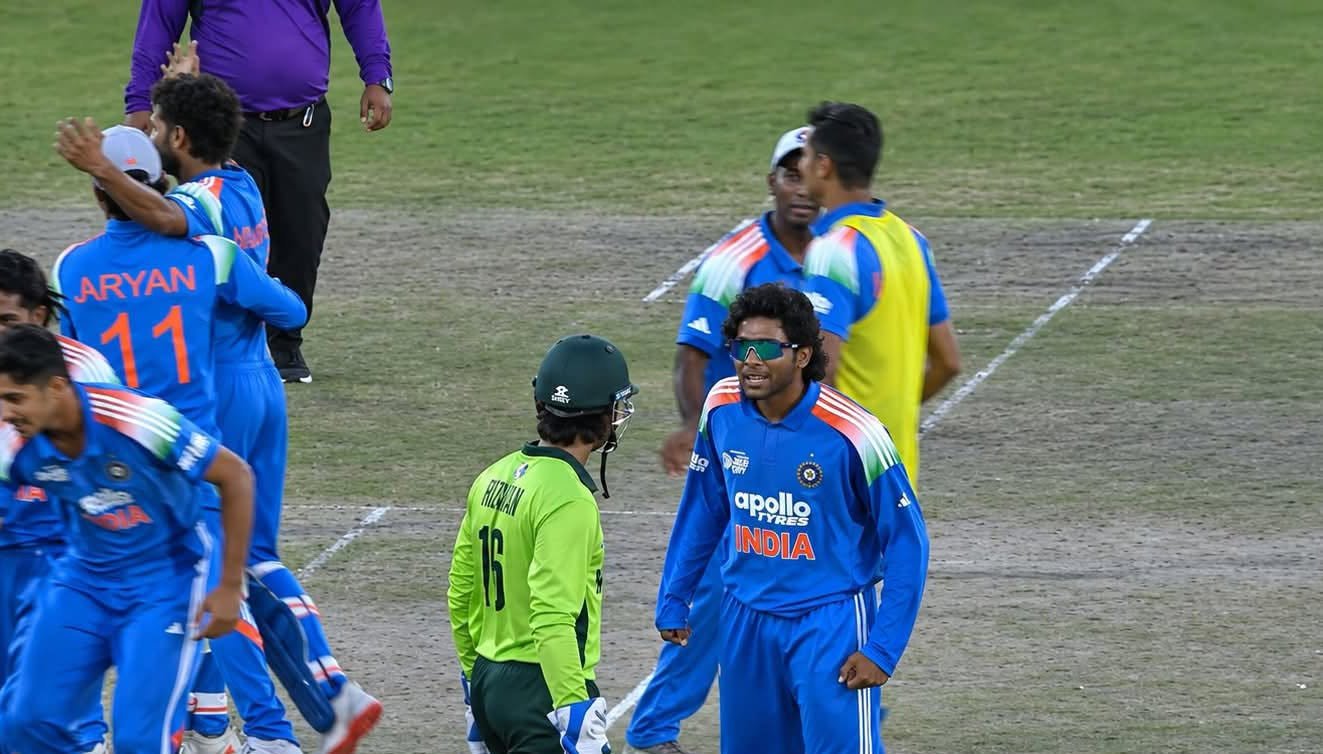
<p>Conduct that disgraced an outstanding last-ball victory</p>
<p>The Under-19 Asia Cup final, played in Oman on 14 November, showed the competitiveness of cricket. It showed the quality of fighting to the end.</p>
<p>Pakistan scored 337 for nine wickets. India had lost eight wickets for 252 runs. Victory had turned towards Pakistan. But Manal Chauhan and Mohit Ulwa brought India back into the match. Three runs were needed for victory off the last ball. Ulwa hit that ball for four.</p>
<p>India won the Asia Cup by one wicket. There was fight in the victory.</p>
<p>But what happened afterwards?</p>
<p>Indian players ran onto the field. They shouted with joy. All of that is normal. But some players went up to the defeated Pakistani players and made aggressive gestures. Some of the gestures were obscene. What we saw was the way they shouted and discharged their own impulse. Members of the Indian coaching staff intervened to control the situation.</p>
<p>The Indian Express, India Today and Rediff in India, and The Express Tribune in Pakistan, reported the incident. Some reports specially mentioned gestures Manal Chauhan made towards Pakistan wicketkeeper Hamza Zahoor.</p>
<p>Politics that began with not shaking hands</p>
<p>This is not an isolated incident. During the Asia Cup tournament held in September 2025, the Indian national team refrained from shaking hands with Pakistani players. That decision was taken amid the political and military tension that arose between the two countries after the Pahalgam attack in Kashmir. Indian captain Suryakumar Yadav linked his team’s stance to guidance from the Indian government and the cricket board.</p>
<p>It did not end there. That behaviour spread to the women’s national team and to junior teams as well. In the Women’s Asia Cup match in September 2026, the two countries’ captains also refrained from shaking hands. Yesterday, these immature boys did not shake hands at the toss before the final, or at the end of the match. What happened at the end of the match, the article says, was the frenzy of Indian lads who seemed ready to fall on the Pakistani youths.</p>
<p>This crisis questions human ethics. There can be a political conflict between two countries. There can be disputes over borders. There can be accusations about terrorism and problems connected with national security. But those responsible for them are the rulers of the state. Resolving those problems is not the task of cricket players. Their main responsibility is to the game. The hostility began with not shaking hands. When that continues to be practised on the field as a political protest, what is questioned is the culture of respecting the opponent. The next step can be to treat the opponent as an enemy. What we saw yesterday inside 70 yards, the article says, were expressions of that frenzy.</p>
<p>Who is responsible for the children’s behaviour?</p>
<p>There is little use in scolding these youngsters who are not even 19 years old. These loutish boys know neither cricket, nor politics, nor a gentleman’s game. They have no example for that either. The problem is not with these youngsters. It is the absence of elders who can teach them the ethics of the game.</p>
<p>A young player observes the national team. He follows its captains. He takes as an example the behaviour approved by his country’s cricket administrators. What should now be examined is what kind of cricket India has shown so far. In an environment in which senior players’ refusal to shake hands with the opponent is presented as national pride, it is no surprise that a young player mistakenly understands humiliating the opponent as part of patriotism.</p>
<p>The Spirit of Cricket declaration, which is the foundation of the Laws of Cricket, specially states that the responsibility for maintaining discipline in the junior game also falls on teachers, coaches and parents. Respecting the opponent and thanking him at the end of the match are its basic values. Yesterday, coaches had to intervene on the field to control the Indian players. That is not a normal thing. It is the moral side of their coaching method being left naked before the world. What we saw, the article says, was that repulsive nakedness.</p>
<p>Power in the cricket market and moral responsibility</p>
<p>India is the enormous economic power of world cricket. Its spectator market, broadcast revenues, sponsorship and the Indian Premier League have a large effect on the international cricket economy. Power of this kind should come with proportionate responsibility. It should be recorded that using that power, once responsibility has been sent into exile, as a licence to suspend the ethics of the game is the tragedy the whole sport is experiencing at this moment.</p>
<p>There is another contradiction here. If playing with Pakistan is a harm to national pride, the political decision about holding those matches should be taken openly. But what is the logic of taking part in the match, enjoying its economic and competitive benefits, and rejecting basic respect for the opponent? The Board of Control for Cricket in India should answer this contradiction.</p>
<p>At the same time, the International Cricket Council is not free of its responsibility either. The council has a formal code of ethics to control players’ misconduct. Its purpose is to protect the honour and credibility of cricket. If so, will a formal inquiry be held into yesterday’s incident? Will the footage be examined and responsibility determined? Will disciplinary steps be taken if necessary? These are specific questions that should be asked.</p>
<p>India won. But what was defeated?</p>
<p>The cricket skill shown yesterday by India’s junior team should be valued by us as adults. But they are still children who are associating with cricket and learning the game. A victory gained by fighting until the last ball is part of a great experience in their lives. That victory is not enough to produce an outstanding player. Greatness is a character that has to be acquired, existing in another, deeper dimension. India had such a great tradition. Players who were an ornament to world cricket culture were produced from India. What has today been subordinated to petty tribal politics, the article says, is that inviolable tradition.</p>
<p>Using for that purpose a group of children who do not know about life, do not know about cricket, and do not know the seriousness of their own behaviour is, the article says, the greatest crime India has committed. We have no understanding, the writer says, of how India explains allowing its ugly political rivalry to become normalised in the behaviour of the next cricket generation. The truth, the article says, is that the junior Asia Cup India won yesterday has not added even a mustard seed’s worth to the game. What the world saw was an omen of the death of future cricket. If world cricket administration continues to allow this tribal dance, heaven help the game of cricket.</p>
<p>Translated from the LSN Sinhala edition.</p>