Opinion: 'Moral panic' and political plunder on sacred ground: why we should listen to the chief monks of the Atamasthana
The true respect we owe the Atamasthana should be measured not by how angry we get or how many coconuts we smash in its name, but by how wisely and responsibly we act to protect both its historic heritage and the dignity of the people who come to it.
LSN Sri Lanka ·
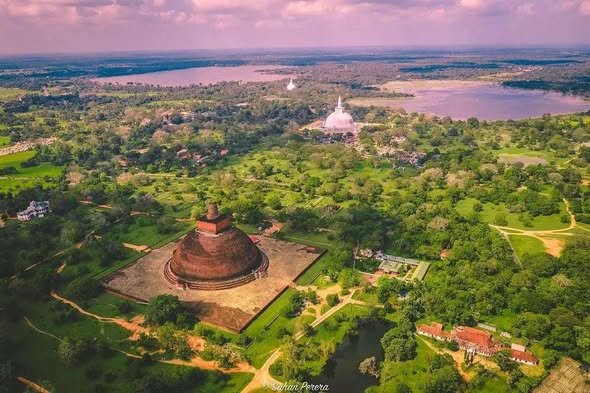
<p>Anuradhapura is not merely a geographic space or a collection of stone ruins. In sociological terms, it is a living social institution at the centre of the collective memory, cultural identity and spiritual aspirations of many generations. The man who raises his joined palms before the Sri Maha Bodhi and the woman who sits in silence on the Ruwanweliseya terrace do not come out of a tourist's curiosity about an old building. There they connect with a historical current larger than themselves, and with a spiritual world that gives them the strength to bear impermanence and suffering.</p>
<p>So it is entirely natural for society to be sensitive about any change on the Atamasthana grounds, and that collective sensitivity deserves respect. But turning people's genuine devotion and love for the sacred site into an organised "moral panic", and using that fear to fuel narrow political power projects, is a completely different kind of socio-political plunder. The decisive challenge before us today is to draw a clear line between that genuine sensitivity and politically manufactured fear.</p>
<p>That ideological operation is exactly what we see in the current dispute over the Anuradhapura Sacred City plan. The moment unscientific and fictitious allegations such as "a Ram temple is being built" entered the legitimate public concern about protecting the site, the whole public conversation was dragged away from the rational ground of pilgrims' facilities, conservation of antiquities and the sacred environment. From then on, it has been driven as an emotional uproar built around the myth that "religion and the nation are in danger".</p>
<p>The weight of custodianship and the noise of outsiders</p>
<p>Yesterday's (16) media briefing at the Buddhasasana Ministry has to be read against this socio-political background. What the acting Chief Prelate of the Atamasthana and chief custodian of the Ruwanweliseya, Ven. Eethalawetunuwewe Gnanathilaka Thera, and the chief incumbent of the Abhayagiri Vihara presented there were not the views of people setting agendas on social media or in air-conditioned halls in Colombo. It was a direct explanation by the chief monks who answer to the whole nation and to history for the historic sacred site in their care.</p>
<p>Their relationship with these holy places is not that of a guest who attends a ceremony and leaves. They see with their own eyes the hundreds of thousands of people who come to this sacred ground every day, their basic needs, the environmental and physical damage to the site, and the practical difficulties of preventing it. For them, protecting the sacred site is not a slogan limited to a media statement but a responsibility they carry every day of their lives.</p>
<p>Society should therefore recognise the institutional and moral weight of this statement. A responsible explanation given by those who hold historic custodianship of a specific site and take part directly in the discussions on decisions about it cannot be placed on the same level as an allegation spread from outside for political advantage. The chief monks' appeal is very simple (translated): "Join us in protecting this land. Put forward your ideas. Discuss the changes that are needed. Do not wreck the work out of needless fear." It is an open invitation to society for responsible civic participation.</p>
<p>The Ram temple fiction and fear of 'the other'</p>
<p>The monks directly rejected the claim being spread that a Ram temple is to be built in the Anuradhapura Sacred City with Indian aid, describing it as the most sensitive and also the most baseless issue in this debate.</p>
<p>The chief incumbent of the Abhayagiri Vihara explained that this Indian aid came at the request of the late former Chief Prelate of the Atamasthana when Indian Prime Minister Narendra Modi visited to worship the Jaya Sri Maha Bodhi. He stressed that its only aim was to develop the common facilities needed by devotees coming to the Atamasthana, including the Maha Vihara, on a par with international-level sacred sites such as Bodh Gaya and Sarnath, and that it carried no condition to build any other religious shrine.</p>
<p>We have past experience of irrational protests being manufactured against projects carried out with Indian support, for the sake of very narrow political interests. One example is the Suwa Seriya ambulance service in 1990. It was introduced to this country with Indian aid through the intervention of Dr Harsha de Silva, who was then State Minister of National Policies and Economic Affairs, as well as non-Cabinet Minister of Economic Reform and Public Distribution and Deputy Minister of Foreign Affairs. The opposition the Government Medical Officers' Association whipped up against that worthy project was so strong that Suwa Seriya ambulances were not even allowed to park inside hospital grounds and had to be parked at the nearest police stations. Yet today that same ambulance service has become one of the most outstanding parts of the country's free health service. In the "Ram temple" panic woven around the development of the Anuradhapura Sacred City, we are seeing that dark past repeat itself.</p>
<p>It was also confirmed that no "new construction" that would change the ancient character of a UNESCO World Heritage archaeological site such as the Atamasthana will take place, and it was stressed that the country's legal framework leaves no room for such a thing. It was given as an assurance that only infrastructure development for the convenience of pilgrims will be carried out, such as improving toilet systems, reducing traffic congestion, laying out cycle and pedestrian lanes and upgrading museum facilities.</p>
<p>An ideological fear built around a fence</p>
<p>The chief monks' answer to the debate over the fence also reflects a practical reality. Gnanathilaka Thera said there had been a request to complete the remaining part of a fence built some time ago. Its only purpose was to control damage from animals, waste disposal, vehicles parking on antiquities and unauthorised construction. The monks said there was a practical need, if possible, to fence the entire Atamasthana.</p>
<p>The "fence" that political propaganda had turned into a frightening symbol of the sacred site being cut off and walled away from devotees was confirmed, in the custodian monks' account, to be no more than a practical protection need. Beyond that, he explained that the fence proposal has now been dropped, and that ideas about fences around Isurumuniya, Vessagiriya and Ranmasu Uyana were only at the concept stage. The monks stressed that not every idea in the plan is a final, unchangeable decision. These proposals are open to discussion, and a proposal can also be dropped. But when something proposed, something being implemented and something abandoned are mixed together and spread through society, the public's room to understand the truth is closed off. That is what has happened.</p>
<p>The unseen labour behind the spirituality of pilgrimage</p>
<p>The most human and sociologically important part of the media briefing was the account of the day-to-day management of the sacred site. A devotee who comes to the Ruwanweliseya and offers flowers gains spiritual comfort from that offering. But who removes what is left after the flower offerings of thousands? Who keeps the terrace clean? Who maintains the toilet systems?</p>
<p>The chief monk spoke about that unseen labour and administrative responsibility. He pointed out that on some days 12 tractors are needed to clear the flowers, and that more than 200 tractor-loads of sand a year are needed to maintain the sand terrace. He also noted that not everyone who organises large-scale religious events takes responsibility for the basic sanitation facilities of the people who attend. The monks revealed the practical limits on what they can do for devotees left helpless without even a drop of water on such occasions.</p>
<p>This is not a physical story separate from the spiritual meaning of the sacred site. Clean water for a thirsty pilgrim, easy movement for an elderly person and a clean toilet for a child are directly tied to the dignity of pilgrimage. Protecting culture does not mean only gazing respectfully at an old building from a distance. In that context, it also includes protecting the human dignity of the people who come to worship.</p>
<p>Scientific knowledge and public good for a living heritage</p>
<p>Anuradhapura should be conserved not as a dead museum but as a living sacred city. It holds ancient monuments as well as the movements of people living today. Protecting both this living existence and its antiquity at the same time requires scientific knowledge from fields such as archaeology, water management and urban planning. The chief monks' request to set up an expert council reflects a vision of combining religious custodianship with modern specialist knowledge. That think tank has now been set up with the participation of 32 people.</p>
<p>Gnanathilaka Thera also explained that there is no intention of forcibly removing people living in the Sacred City, and that the proposed satellite town at Lolugaswewa, with schools, banks and legal land ownership, is being created for eligible people who are willing to leave the Sacred City voluntarily.</p>
<p>The chief monks also humbly acknowledged the failure to communicate the facts properly to the public at the outset, and have left the door open for amendments to the gazette and for public input.</p>
<p>The 'devotional market' and the responsibility of the thinking citizen</p>
<p>Finally, we invite thoughtful readers to look at this whole crisis from a deeper sociological angle.</p>
<p>In Sri Lanka's socio-political history, the slogan "our religious heritage is in danger" is the most powerful ideological weapon for crippling any rational debate. Even though we know that archaeological or urban planning problems cannot be solved by smashing coconuts, cursing or praying for supernatural destruction, what some political forces want is not to solve the problem but to secure their own political survival by "keeping the problem alive". This is a process of selling religious sensitivity in a "political market".</p>
<p>The chief monks of the Atamasthana are asking people not to believe that they would allow a historic heritage that 104 kings protected with their lives, and that is bound up with their own bones, flesh, blood and veins, to be destroyed under their custodianship. It is true that there are past experiences that call the validity of that request into question. But at this moment, what they are asking for is an approach of wise dialogue instead of blind fear. That is where the difference lies.</p>
<p>Against this background, the choice before us today is clear. Do we choose the "outside noise" that sows hatred and fear through social media, or the accountable statement, grounded in practical experience, of the custodian chief monks who bear the daily joys and sorrows of the sacred ground? That is for us to decide.</p>
<p>We respectfully say to the ladies and gentlemen who are trying to bury it that the true respect we owe the Atamasthana should be measured not by how angry we get or how many coconuts we smash in its name, but by how wisely and responsibly we act to protect both its historic heritage and the dignity of the people who come to it.</p>
<p>Translated from the LSN Sinhala edition.</p>