Opinion: The 323-container debate — how political allegations and the Customs statement were exposed in Parliament
It was seen in Parliament today, the article argues, that politics of a century ago is no longer valid for this society. If fools who blindly follow insolent lies still existed in this society, a social upheaval would not have taken place and a political party that represented 3 per cent of popular support would not have obtained government power. What people such as Ajith P. Perera must understand, the writer says, is that the public they are still talking to has changed from several decades ago.
LSN Sri Lanka ·
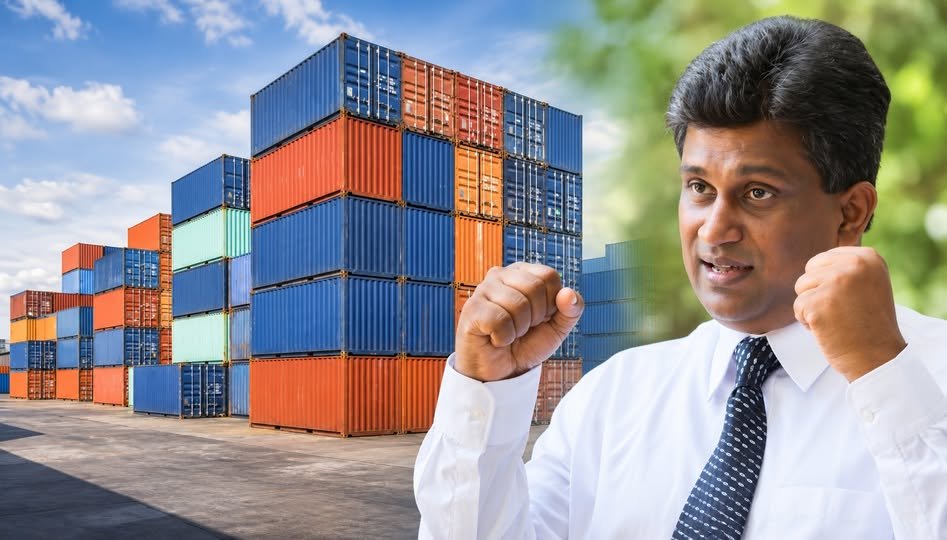
<p>Member of Parliament and lawyer Ajith P. Perera, who went to paint a completely different picture on the basis of the facts that had been built up about the 323 containers, was today left logically exposed inside Parliament, the article says.</p>
<p>Going back to the House with the argument constructed by the Opposition, led by Ajith P. Perera, that a general order given by the government to ease the heavy congestion that had arisen in the port had been pinned specifically to 323 containers, Ajith P. Perera was fully revealed, the article says.</p>
<p>The incident in which 323 containers were said to have been released without a Customs examination during the process of clearing container congestion at the port is a story that created a fierce political discussion both inside and outside Parliament. This process, which took place in January 2025, was again raised today by Ajith P. Perera in the budget debate.</p>
<p>The Opposition’s allegation and the request to summon witnesses</p>
<p>SJB Member of Parliament and lawyer Ajith P. Perera alleged in Parliament that 323 containers that had been classified in risk categories had been released without examination, and that instructions from the president and the ministers in charge of ports had influenced that.</p>
<p>He based this allegation on a media statement issued by the Director General of Customs on 29 January 2025. Ajith P. Perera said that, through that statement, which had been marked ‘X’ in inquiries, the Director General of Customs had stated that he had acted on the instructions of political authorities. The MP said he had therefore recommended that the Minister of Finance, the Minister of Ports, the Deputy Minister of Ports and the Secretary to the Ministry of Finance should be summoned before the parliamentary select committee.</p>
<p>The MP then presented another serious allegation. He said that on 22 April 2026 the list of witnesses he had submitted had been rejected on the votes of government-party MPs. He also criticised the delay in the report because the committee had not met after 22 July.</p>
<p>The government side’s position and the challenge</p>
<p>The committee’s chairman, Justice Minister Harshaana Nanayakkara, then rose. He said the elementary politics Ajith P. Perera had tried to carry on inside the committee had been rejected by the committee. The minister pointed out that all evidence had now been obtained and completed, that the final draft was being typed, and that there was no use in the committee meeting again without it. He said the committee report would be presented before 22 December.</p>
<p>Meanwhile, answering these Opposition allegations, Ports Minister Bimal Rathnayake directed the debate towards a specific point. He said that giving general instructions to remove container congestion at the port was a responsibility of a minister in charge of the subject, and that he did not deny that he had given such instructions.</p>
<p>He challenged, however, that if there was a document showing that the president, he himself or the deputy minister had ordered Customs to release the specific 323 containers under debate, it should be presented to the House. Minister Sunil Handunnetti also asked that, instead of presenting interpretations of the relevant media statement, the statement itself be read to the House.</p>
<p>What the statement read to the House revealed</p>
<p>It was after the government side’s challenge that Ajith P. Perera had to read the Customs statement of 29 January 2025 to the House. With that, the character of the debate reached a decisive stage. Several main points mentioned in that statement were as follows:</p>
<p>• Beginning of the method: to prevent delays in the clearance of essential goods and industrial raw materials because of port congestion, a method of selecting and releasing containers whose risk could be borne was begun from 18 July 2024. That was with the approval of senior Customs management and under the supervision of an Additional Director General of Customs.</p>
<p>• Selection criteria: these containers were selected by a unit of experienced senior officers, on criteria such as complete details having been submitted to identify the goods, and goods of several importers not being contained in the same container.</p>
<p>• Involvement of political authorities: on 12 January 2025 the president and the committee chairman, Bimal Rathnayake, instructed that the container-clearance process be expedited. Thereafter, the committee that met on 18 January “released the relevant number of containers according to the relevant criteria”.</p>
<p>The overall picture of the debate</p>
<p>As Minister Sunil Handunnetti pointed out, it is clear from that statement that the present administration gave instructions to expedite clearance according to a Customs method that had been begun during the government that existed in 2024.</p>
<p>Although Ajith P. Perera continued to maintain his position that those instructions were contrary to Customs procedure, there is, in the official document he himself read to the House, no mention of a separate order given by the president or the ministers to release, specifically and without examination, the 323 containers that gave rise to the controversy.</p>
<p>Accordingly, the gap between general instructions given to expedite an administrative process and an order given to release a specific consignment of containers was revealed in this parliamentary debate.</p>
<p>Ajith P. Perera, the article says, sank in a somersault inside the lie he himself had built. The form of politics is this uncivilised, the writer says. Ajith P. Perera is not a fool. He knows the reality of all this well. Knowing that reality, he socialises an insolent lie and lets a distorted view loose in society.</p>
<p>It was seen in Parliament today, the article argues, that politics of a century ago is no longer valid for this society. If fools who blindly follow insolent lies still existed in this society, a social upheaval would not have taken place and a political party that represented 3 per cent of popular support would not have obtained government power. What people such as Ajith P. Perera must understand is that the public they are still talking to has changed from several decades ago.</p>
<p>What Ajith P. Perera and his group must now do, the article says, is to change their own politics to correspond to that public.</p>
<p>Translated from the LSN Sinhala edition.</p>