Opinion: The teacher-principal strike – the real critique of the 2027 budget, salary anomalies and a deep crisis in education
In the end, it is cornered in a place with no shame about morality. No trade union movement should fall to that level, because a country's journey towards social justice needs a meaningful trade union movement.
LSN Sri Lanka ·
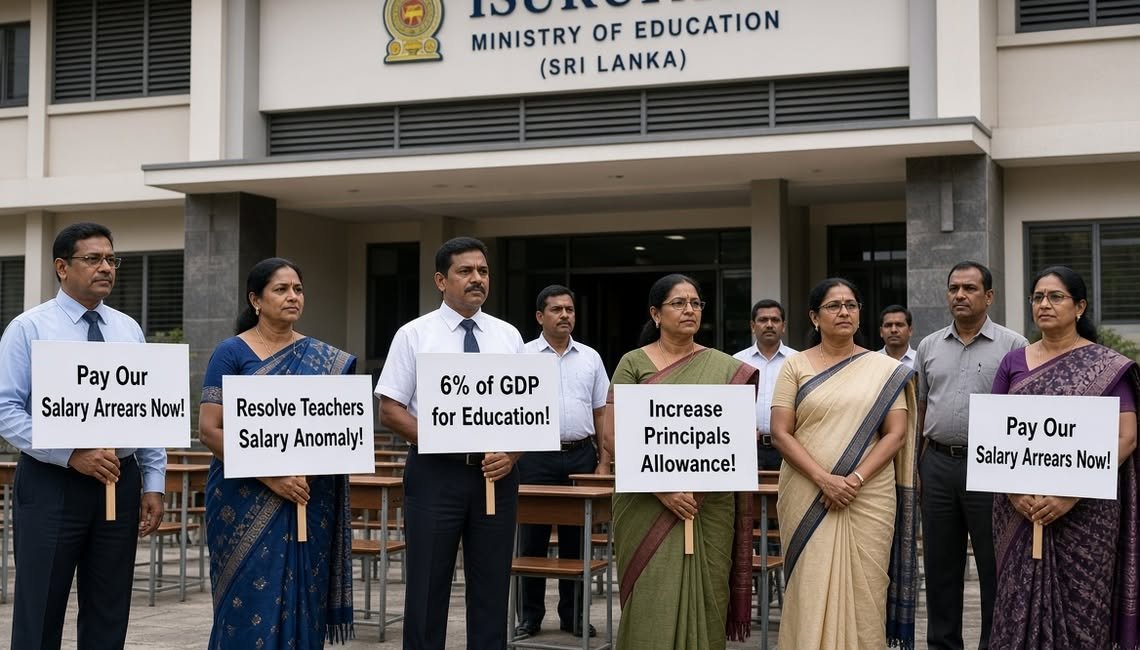
<p>Teachers and principals across the island have decided to launch a massive trade union action on 30 November, reporting sick and shutting down the entire school system. The Joint Teacher-Principal Trade Union Alliance says it is taking this step in protest at the government's failure to provide a proper solution through the 2027 budget to its long-standing salary anomalies and service problems.</p>
<p>Before that, on 23 November, they also plan to stage a protest by reporting for duty dressed in black. The main aim is to put pressure on the government ahead of the budget debate scheduled for 1 December.</p>
<p>The argument the unions put forward for this action may look simple at first glance, but the real critique running beneath it is far deeper and more complex. It goes beyond a mere question of a pay rise and calls for an investigative reading of the structural crisis in the country's education system, the limits of public finances, political priorities and the serious harm done to schoolchildren's right to education.</p>
<p>The background to the demands, the weight of history and the unions' charges</p>
<p>The main demands put forward by the unions include the immediate payment of the remaining two-thirds of the salary increase promised under the Subodhini Committee recommendations; an interim allowance of Rs 25,000 until the salary anomaly is fully resolved; a principal's allowance for all grades of principals; higher difficult and very difficult area allowances; allocating 6 per cent of gross domestic product (GDP) to education; and expanding the school nutrition programme. They are also pressing for the extra administrative burden placed on teachers to be removed.</p>
<p>Union leaders sharply question the government's budget priorities. They point out that while the budget has allocated funds to raise police allowances by Rs 10,000 and to recruit 24,000 new police officers, the government has failed to fill the severe vacancies in the school system or to resolve teacher-principal problems. They also accuse the government of completely ignoring a special set of proposals they submitted for the budget.</p>
<p>This salary anomaly is not something that arose yesterday or today. The unfair pay gap was created because moving from the teaching service to the principals' service is treated not as a "promotion" but as a "new appointment". When a Grade I teacher is appointed to Grade III of the principals' service, differences in salary increments widen the gap further over time. The 2014 service minute and related circulars made the problem worse. Although a circular was issued in June 2026 approving the calculation of principals' starting salaries as a promotion, the unions say this is not an adequate solution to the overall problem.</p>
<p>The government's position, the statistics and the financial reality</p>
<p>The government's response to these union charges, however, is based on statistical and financial reality. The 2027 budget has allocated a massive Rs 110 billion to implement the third and final stage of the overall public sector salary revision from 1 January 2027.</p>
<p>Government data show that, compared with salaries at the end of 2024, pay in the teaching and principals' services will rise markedly by January 2027:</p>
<p>Teaching Service Class 3 Grade II: from Rs 31,490 to Rs 53,060 (an increase of Rs 21,570, or 68.50%).</p>
<p>Teaching Service Class 3 Grade I: from Rs 34,160 to Rs 57,860 (an increase of Rs 23,700, or 69.38%).</p>
<p>Teaching Service Class 2 Grade II: from Rs 39,175 to Rs 66,880 (an increase of Rs 27,705, or 70.72%).</p>
<p>Teaching Service Class 2 Grade I: from Rs 47,425 to Rs 81,780 (an increase of Rs 34,355, or 72.44%).</p>
<p>Teaching Service Class 1: from Rs 56,770 to Rs 98,580 (an increase of Rs 41,810).</p>
<p>Principals' Service Grade III: from Rs 42,175 to Rs 72,280 (an increase of Rs 30,105).</p>
<p>Principals' Service Grade II: from Rs 48,685 to Rs 86,370 (an increase of Rs 37,685).</p>
<p>In addition, this budget has allocated funds to raise the salaries of teacher advisers and to increase their allowance from Rs 10,500 to Rs 20,000.</p>
<p>Deputy Minister of Labour Mahinda Jayasinghe points out that public sector salaries have been raised on three occasions over the past two years, and that going on such a strike when the next stage is due in January 2027 is completely unfair. He stresses that while the country's total capital expenditure is Rs 2,000 billion, Rs 2,160 billion is spent on public sector salaries and pensions alone.</p>
<p>In other words, more money is spent on paying public sector salaries than on the country's entire capital expenditure for development. Furthermore, as Prime Minister and Education Minister Dr Harini Amarasuriya has stated, the report of the special commission on salary anomalies is due in July 2027.</p>
<p>The real critique: students, the teacher shortage and a systemic crisis</p>
<p>Looked at critically, the main criticism of this strike is the serious harm it does to the education of innocent schoolchildren. There is strong criticism in society in particular over attempting to close schools during a crucial period when government examinations are being held in the school system. Although the unions say "the government must take responsibility for schools closing" (translated), a public view is forming that turning children's right to education into a bargaining weapon can in no way be justified.</p>
<p>The unions themselves acknowledge that there is already a massive shortage of 40,000 to 50,000 teachers in the country. The situation is extremely acute in the Eastern, North Central, Uva and Northern provinces. Against a backdrop where even the planned recruitment of 23,000 new teachers is not enough, paralysing schools by reporting sick multiplies the existing crisis two or three times over. It leaves Ordinary Level (O/L) and Advanced Level (A/L) students utterly helpless and forces parents to spend heavily on private tuition classes. This undermines the very core and equality of free education in this country.</p>
<p>Second, there is the risk of ignoring the country's economic and financial reality. At a time when Sri Lanka is still trying to stabilise its economy within the limits of an International Monetary Fund (IMF) programme, allocating additional money such as the Rs 70 billion needed to fully implement the Subodhini recommendations is not practical. To find that kind of money, the government would again have to load the tax burden onto ordinary people or cut other essential development spending. Granting special allowances to just one sector also risks creating a new wave of salary anomalies across the entire public service.</p>
<p>Third, there is the monotonous and narrow nature of trade union action. Although teacher-principal strikes have been held in this country for decades, the unions' contribution to basic structural reforms such as improving the quality of education, updating outdated curricula and developing infrastructure in rural schools remains minimal. Instead, all their slogans are focused only on short-term financial demands.</p>
<p>Collective responsibility and the way forward</p>
<p>The cost-of-living pressure faced by teachers and principals, and the hardships of serving in difficult areas, are a truth no one can dismiss. Their salary anomaly must receive a lasting solution. The problem lies with the unacceptable conduct of paralysing the school system on 30 November, when a significant salary increase is due in January 2027 and the salary commission report is due in July 2027.</p>
<p>This crisis can be resolved not by taking to the streets or closing schools, but only through open and responsible dialogue between the government and the unions. The government must set a clear timetable for resolving the salary anomalies, while the teacher-principal community, as public servants paid from the taxes of ordinary working people, is also bound by its conscience to protect the future of schoolchildren. No one has the right to sacrifice students' right to education to a salary dispute.</p>
<p>In the end, it is cornered in a place with no shame about morality. No trade union movement should fall to that level, because a country's journey towards social justice needs a meaningful trade union movement.</p>
<p>Translated from the LSN Sinhala edition.</p>