World · Malaysia Bureau
Physicist wins Nobel Prize for detecting cosmic 'ghost particles'
Francis Halzen has been awarded the 2026 Nobel Prize in Physics for his pioneering work with the IceCube Neutrino Observatory in Antarctica. The honour recognises his fundamental contributions to detecting high-energy neutrinos originating from beyond our solar system.
LSN Malaysia ·
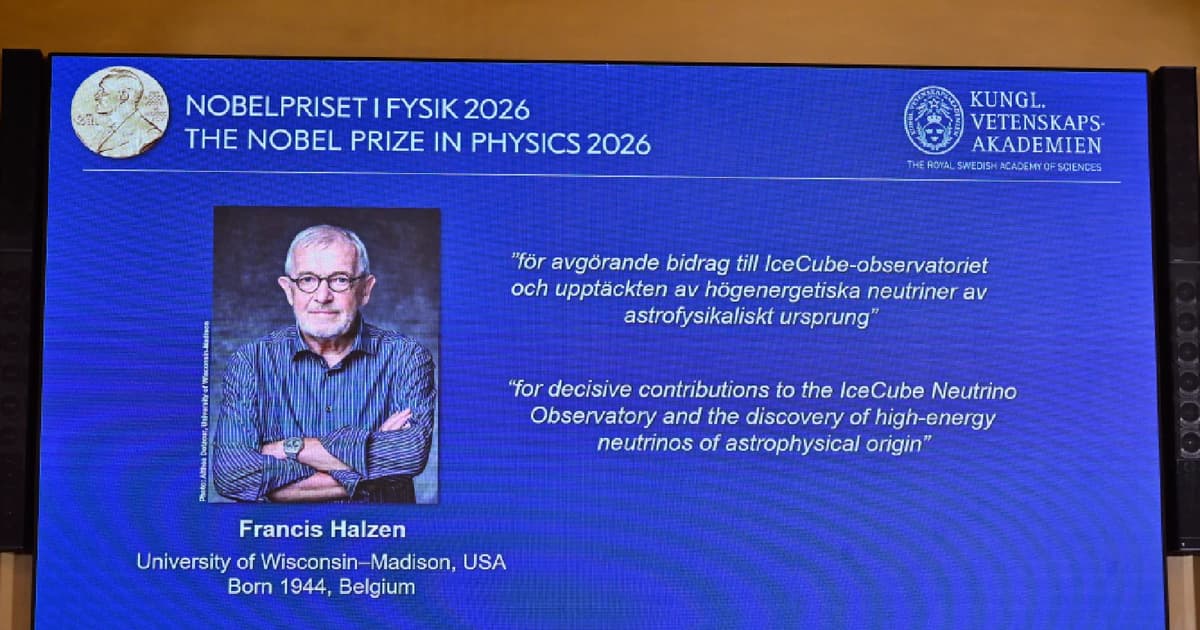
The Nobel Committee has recognised Halzen's instrumental role in establishing and operating the IceCube facility, which has transformed understanding of particle physics and astrophysics. The observatory, buried beneath the Antarctic ice sheet, represents one of the most ambitious scientific ventures to detect elusive neutrinos—subatomic particles that travel vast cosmic distances with minimal interaction with matter.
Neutrinos are produced by some of the universe's most violent phenomena, including supernovae, black holes, and gamma-ray bursts. Despite their abundance, these particles are extraordinarily difficult to detect, earning them the colloquial designation of "ghost particles" within the scientific community. IceCube's detection of high-energy neutrinos from space has opened a new window for observing the cosmos and understanding extreme astrophysical events.
The achievement marks a significant milestone in multi-messenger astronomy, a field that studies the universe through various particle and radiation channels rather than relying solely on traditional light-based observations. Halzen's work has enabled researchers to correlate neutrino detections with observations from other instruments, providing unprecedented insights into cosmic phenomena.
The 2026 Nobel Prize in Physics underscores the international scientific community's commitment to fundamental research and innovation. Halzen's recognition highlights the importance of long-term investment in large-scale scientific infrastructure and the collaborative efforts required to push the boundaries of human knowledge about the universe.