Business · Sri Lanka Bureau
Sri Lanka closes $50,000 import advance loophole used to send dollars abroad without goods
Central Bank Governor Nandalal Weerasinghe said the same individuals used different companies at several banks to send repeated advance payments abroad, prompting new checks, a cross-bank tracking system and fines.
LSN Sri Lanka ·
<p>Sri Lanka has tightened its rules on import advance payments after the Central Bank and police uncovered large-scale foreign exchange abuse in which individuals repeatedly sent $50,000 advances abroad through several banks without ever bringing in goods, EconomyNext reported.</p>
<p>Central Bank Governor Nandalal Weerasinghe said the bank's Department of Foreign Exchange is investigating the outflows, which took place under an earlier circular issued by the Finance Ministry's Import and Export Control Department.</p>
<p>Under that circular, importers could obtain an advance payment of up to $50,000 by presenting an invoice at a commercial bank. The remittance is recorded in Sri Lanka Customs' ASYCUDA system, and the importer must bring the goods into the country within 180 days. If the goods do not arrive within six months, Customs is meant to notify the Central Bank so that legal action can be taken against non-BOI companies for breaching foreign exchange laws.</p>
<p>However, Customs did not pass this information to the Central Bank for a long time despite repeated requests, according to the report. The full scale of the abuse came to light only after authorities received tips that some individuals were using the facility again and again, which led to a police investigation.</p>
<p>Investigators found that large amounts of dollars had been sent abroad in $50,000 advances without goods arriving within six months, and that some transactions had never been recorded at Customs at all.</p>
<p>"Some action had been taken regarding the ones that were notified, but it was only later discovered that the number of unnotified cases was massive," Weerasinghe said.</p>
<p>Checks at commercial banks showed the same people visiting different bank branches under the names of different companies to obtain repeated advances. Because banks had to release the money once an invoice was presented, and the non-arrival of goods could only be confirmed after 180 days, the scheme went undetected for months.</p>
<p>To close the gap, importers must now give a Tax Identification Number (TIN) when requesting an advance. The Import and Export Control Department has also issued regulations requiring background checks before funds are released, covering the importer, its beneficial owner, the company and any previous record. A new system lets banks check whether an applicant has already received an advance from another bank.</p>
<p>Law enforcement agencies are treating the cases as fraud. The Import and Export Control Department handles violations involving BOI companies, while the Central Bank's foreign exchange department acts against non-BOI entities once Customs reports them. Weerasinghe said fines had already been imposed on a large number of companies.</p>
<p>The findings come amid a wider probe. In June, President Anura Kumara Dissanayake told Parliament that authorities were investigating about US$1 billion sent out of Sri Lanka since 2023 by telegraphic transfer as import advances without any goods arriving, money he linked to drugs, corruption and organised crime.</p>
<p>This report is based on reporting by EconomyNext.<br>
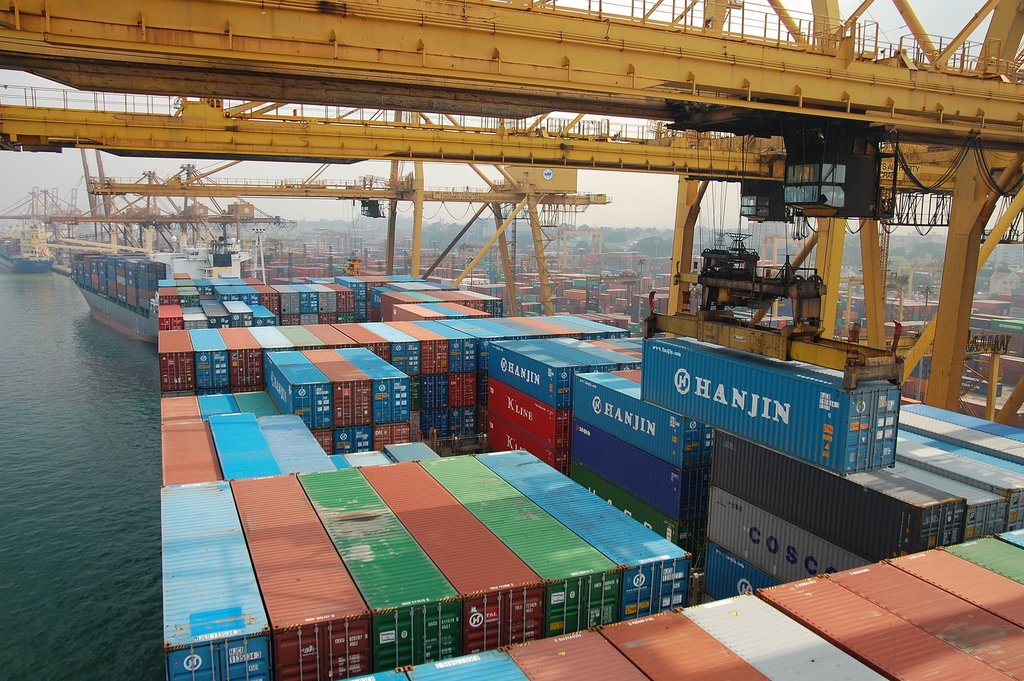
Photo: Containers at the Port of Colombo. jgmorard / Wikimedia Commons (CC BY 2.0), file image.</p>