Politics · Philippines Bureau
Supreme Court dismisses habeas corpus petitions over Rodrigo Duterte's arrest and ICC transfer
Voting 9-4, the court said Philippine courts cannot enforce the writ while the former president is held in The Hague, but stressed it was not ruling that his arrest and surrender were lawful.
LSN Philippines ·
<p>The Philippine Supreme Court has dismissed the consolidated habeas corpus petitions filed by former President Rodrigo Duterte's children challenging his March 2025 arrest and his transfer to the International Criminal Court (ICC).</p>
<p>The decision, written by Associate Justice Japar Dimaampao and dated 11 November, was released on Tuesday, 24 November. The court en banc voted 9-4 to deny the petitions brought by Sebastian, Veronica and Paolo Duterte on their father's behalf. Associate Justice Samuel Gaerlan was on official business and did not take part, according to Rappler and ABS-CBN News.</p>
<p>The court held that habeas corpus, a remedy used to challenge unlawful detention, is a domestic remedy that can only be enforced within the Philippines and not against a person held abroad or by an international tribunal. Because Duterte is in ICC custody in The Hague, Philippine courts cannot enforce a writ affecting his detention or release, it said, and the petitions had become moot.</p>
<p>"Significantly, [Duterte] is not just beyond the Court's coercive powers, but also stands accused before an international tribunal that has assumed jurisdiction over his person," the court said, as quoted by Philstar and the Philippine News Agency.</p>
<p>The justices also noted that Duterte is already taking part in ICC proceedings and using the remedies available there, and that the Philippine officials named in the petitions no longer have custody of him, so they cannot be ordered to produce or release him.</p>
<p>The court stressed that dismissing the petitions does not mean Duterte's arrest and surrender were necessarily lawful, or that his constitutional rights were not violated. The ruling only addresses whether habeas corpus is still an available and enforceable remedy, it said. Any claimed violation of his rights, including claims for compensation or liability, must be pursued through other appropriate legal proceedings. Philstar reported that the court also said it was not deciding whether it is proper for Duterte to seek relief before the ICC, leaving related issues to a separate pending case.</p>
<p>Chief Justice Rodil Zalameda and Associate Justices Marvic Leonen, Alfredo Benjamin Caguioa, Ricardo Rosario, Jhosep Lopez, Dimaampao, Jose Midas Marquez, Maria Filomena Singh and Raul Villanueva formed the majority. Associate Justices Ramon Paul Hernando, Amy Lazaro-Javier, Henri Jean Paul Inting and Antonio Kho Jr. dissented.</p>
<p>Senior Associate Justice Leonen, while agreeing the petitions were moot and that there is no legal bar to Duterte's prosecution before the ICC, wrote that the court should have settled the constitutional questions raised about Section 17 of Republic Act No. 9851, the Philippine law on crimes against international humanitarian law. Among the dissenters, Justice Hernando argued that the surrender violated Duterte's constitutional rights, and Justice Kho described the transfer, made without a local court order, as unconstitutional, according to Philstar.</p>
<p>Israelito Torreon, a lawyer for Duterte in a separate petition over his arrest, said the Duterte camp respectfully disagreed with the ruling and that the court should have decided the case on its merits, Philstar reported. Palace Press Officer Claire Castro said the Marcos administration respects the decision, adding that the government did not abuse its power and followed Republic Act No. 9851.</p>
<p>Duterte was arrested on 11 March 2025 on arriving in Manila from Hong Kong, on an ICC warrant for alleged crimes against humanity linked to his anti-drug campaign, and was flown to The Hague the same day. His children filed the petitions the next day, arguing the warrant could not be enforced because the Philippines had withdrawn from the Rome Statute. He faces three counts of crimes against humanity, which he has not been convicted of, and his ICC trial is set to begin on 30 November, according to the Philippine News Agency and Rappler.</p>
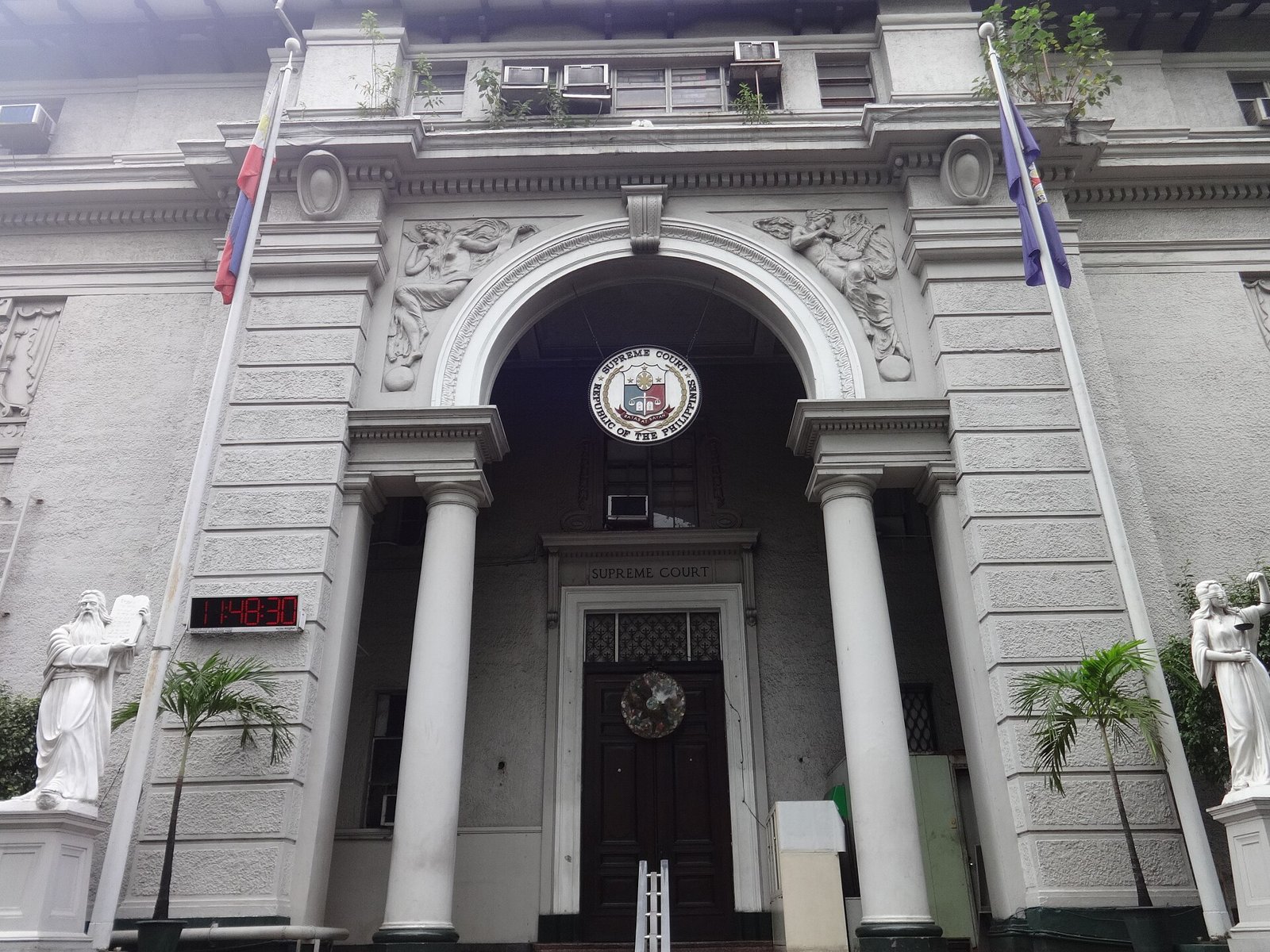
<p>Image: Supreme Court of the Philippines old building, Taft Avenue, Manila (file photo, 2020). patrickroque01 via Wikimedia Commons, CC BY-SA 4.0.</p>