Politics · World News Bureau
US lead over China in Asia shrinks to narrowest since 2018, Lowy Institute power index finds; India consolidates third place
The Sydney-based think tank's 2026 Asia Power Index puts the United States on 78.9 points and China on 73.6, and says the gap in military capability is the smallest on record.
LSN World News ·
<p>The United States remains the most powerful country in Asia, but its lead over China has fallen to its smallest margin since the Lowy Institute began its annual Asia Power Index in 2018, according to the 2026 edition released on 22 November.</p>
<p>The Sydney-based think tank scored the United States at 78.9 points and China at 73.6 for comprehensive power, a gap of 5.3 points. The South China Morning Post noted that the US score fell for a second consecutive year and is its lowest in the history of the index. The gap between the two countries' military capabilities is also the narrowest on record, the report said.</p>
<p>The index ranks countries using 131 indicators grouped into eight measures, including military capability, defence networks, economic capability and relationships, diplomatic and cultural influence, resilience and future resources.</p>
<p>The report's authors, Hunter Marston and Jack Sato, wrote that "this narrowing divide owes more to Washington's missteps than to any advances on Beijing's part". The institute linked the US decline to the war with Iran that began in February 2026, saying it had depleted US stocks of long-range missiles and weakened perceptions of American diplomatic influence. It also pointed to the shift of US naval resources from the Pacific to the Persian Gulf and to fewer joint exercises and defence dialogues with allies including Australia, Japan and South Korea.</p>
<p>China held steady on most measures and gained in military capability, cultural influence and resilience, though it slipped on economic relationships, the report found. China ranked first for economic relationships and diplomatic influence. Sato told Australia's ABC News that the US lead in military capability had shrunk from 27 points in 2018 to just over 15. The report said the United States still holds clear advantages in defence spending, air power and long-range naval forces such as aircraft carriers.</p>
<p>India rose to third place with 40.5 points, consolidating its position as a major power, according to the institute. The gap between India and China is the narrowest since the index began, though China's power remains 80 per cent greater than India's. Survey respondents rated Prime Minister Narendra Modi as the second most effective leader in the region, behind Chinese President Xi Jinping, ABC News reported.</p>
<p>Australia slipped one place to sixth, behind Russia. Across Southeast Asia, government effectiveness declined in nearly every country covered except Singapore, Myanmar and Laos, as higher fuel and fertiliser prices linked to the Middle East conflict hit the region, ABC News reported. Indonesia recorded the steepest fall in diplomatic influence in the region, which the report attributed largely to what it called President Prabowo Subianto's "haphazard approach to foreign policy".</p>
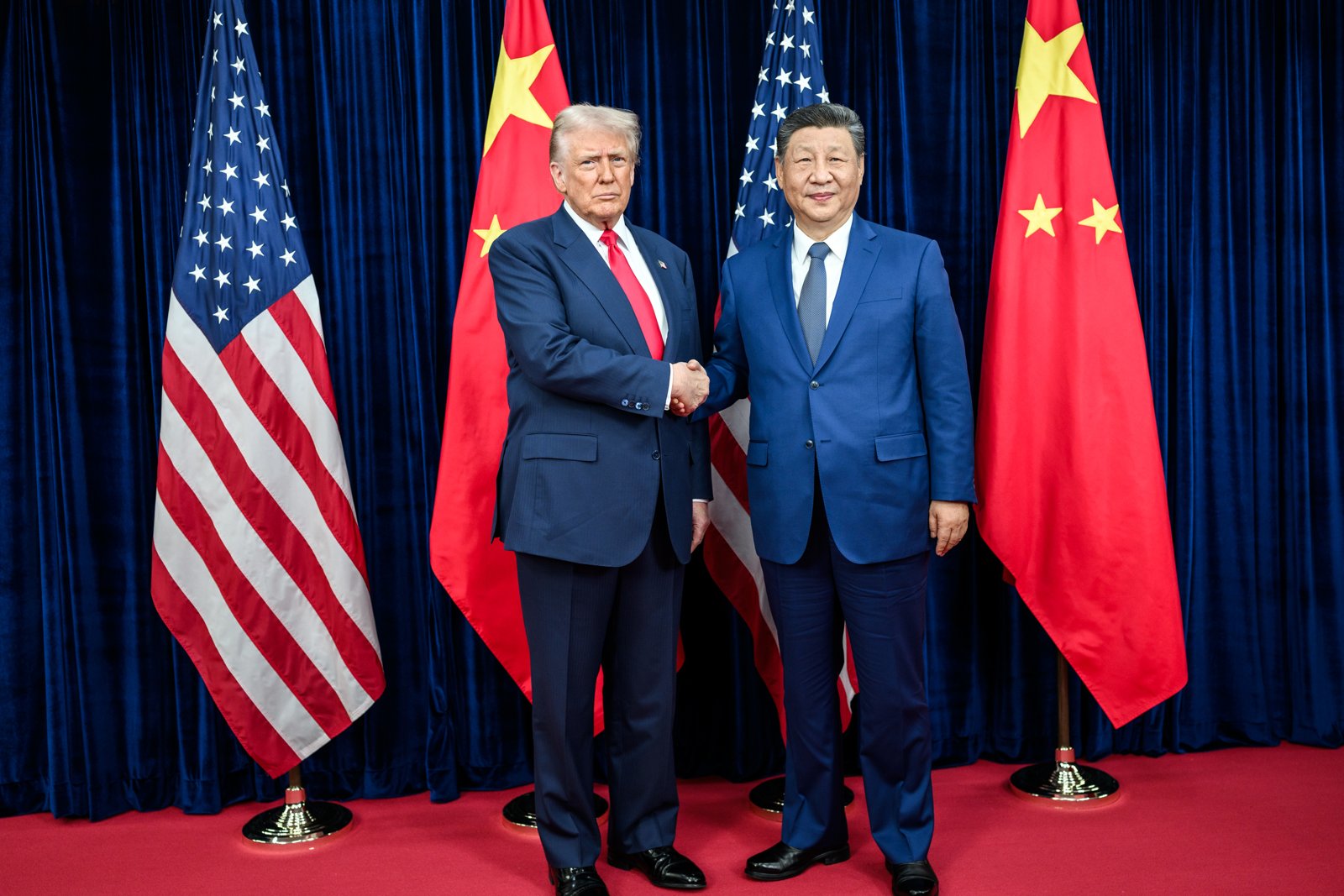
<p><em>US President Donald Trump greets Chinese President Xi Jinping before talks at Gimhae International Airport, South Korea, in October 2025 (file photo). Photo: The White House via Wikimedia Commons, public domain</em></p>