Technology · India Bureau
US researchers develop insect-inspired 'digital brain' for autonomous drones
Scientists at Penn State University are creating an advanced decision-making system for drones based on how insects process information, potentially revolutionizing autonomous flight technology. The $12 million project aims to enable drone swarms to operate independently without external support.
LSN India ·
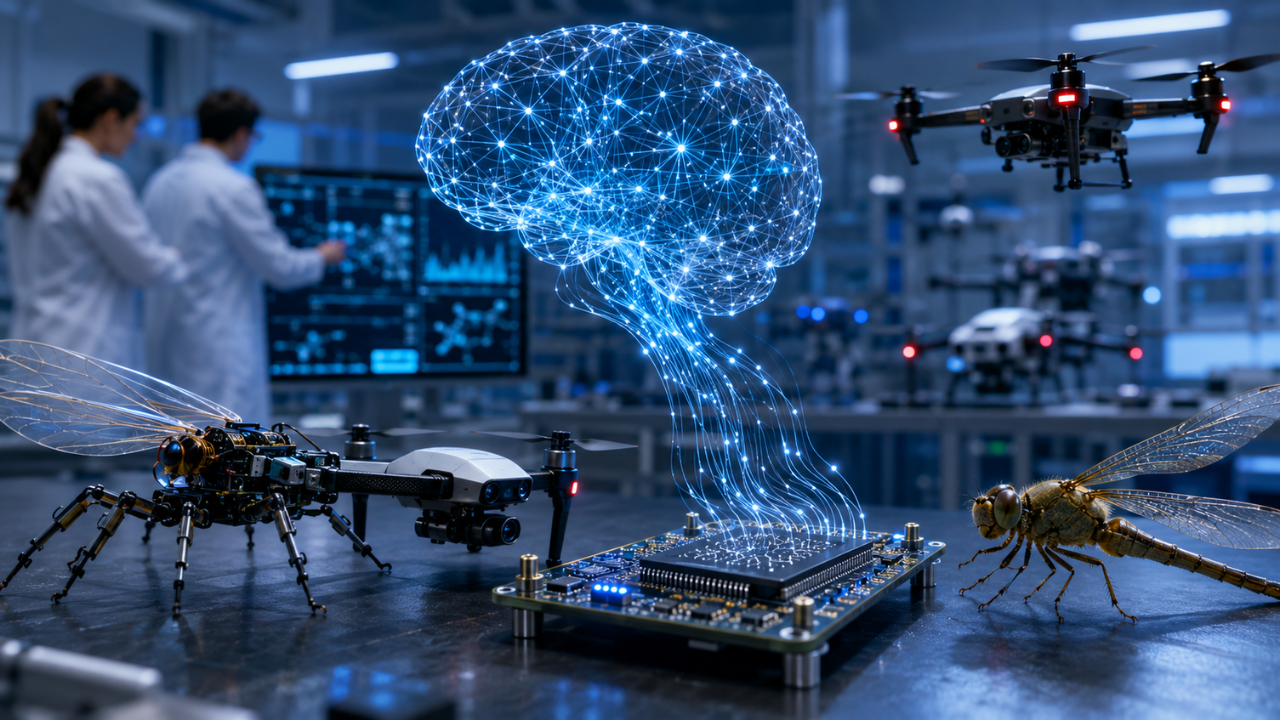
Researchers at Penn State University have initiated an ambitious project to develop artificial intelligence systems for drones modeled after the neural mechanisms of insects. The initiative, valued at $12 million, seeks to create onboard processing capabilities that replicate the natural decision-making processes observed in biological systems.
The research team is combining analogue computing with graphene materials to build what they describe as a 'digital brain' for unmanned aerial vehicles. Unlike traditional digital systems that rely on constant communication with external servers, this approach would enable drones to process sensory information independently and make real-time decisions similar to how insects filter data and detect coinciding stimuli.
A key aspect of the project involves replicating the neural filtering and coincidence detection mechanisms found in insects. These biological processes allow insects to respond rapidly to their environment with minimal computational overhead, making them an ideal model for power-efficient drone systems.
The Penn State team conducts annual demonstrations of prototype iterations as the technology advances. The ultimate objective is to develop fully autonomous drone swarms capable of coordinated operations without relying on external infrastructure or constant human oversight. Success in this field could have significant implications for applications ranging from search and rescue operations to environmental monitoring across challenging terrain.