World · India Bureau
US scientists tracked dye flow in Idaho river using aircraft imaging
Researchers from the US Geological Survey conducted an experiment in 2017 to understand how tracers move through flowing water by releasing dye into Idaho's Kootenai River and monitoring it from above. Advanced hyperspectral imaging from an aircraft provided detailed data on the dye's dispersal patterns.
LSN India ·
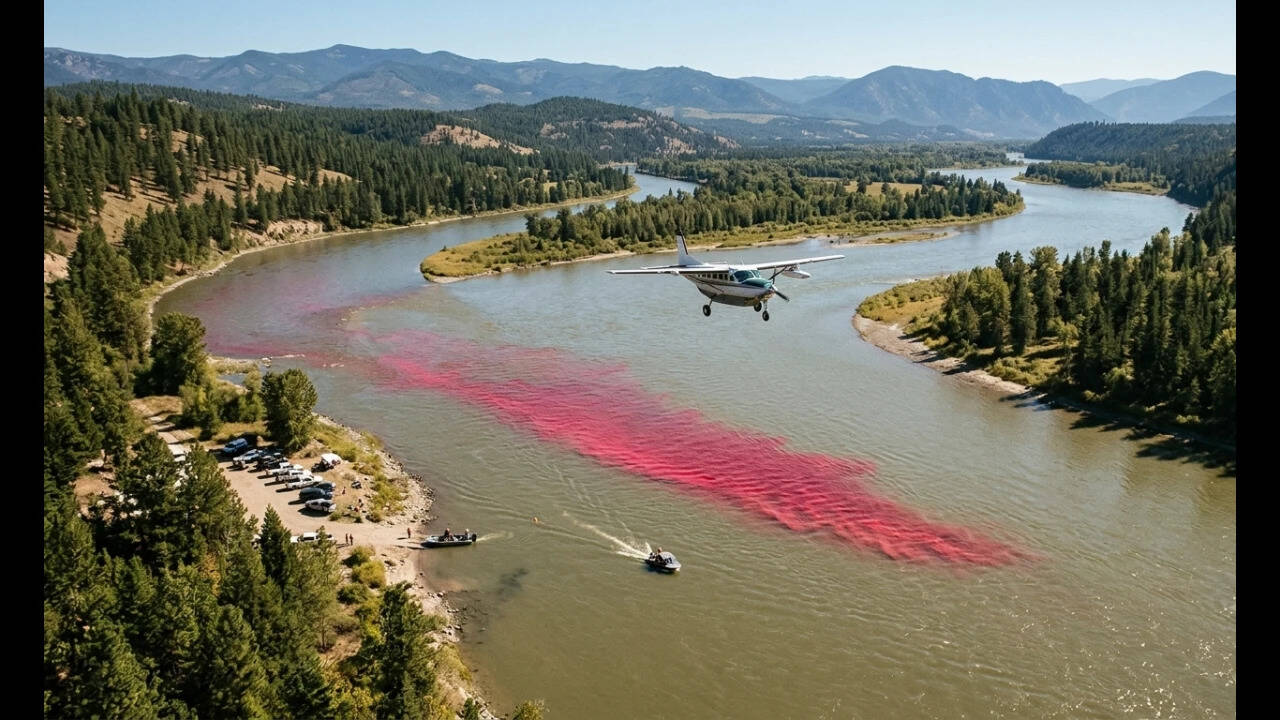
Scientists with the US Geological Survey released 72.57 kilograms of Rhodamine WT dye into Idaho's Kootenai River in a controlled 90-second interval during 2017 as part of a study on tracer movement through flowing water systems. The experiment combined ground-based measurements with advanced aerial observation techniques to track the dye's path and dispersion.
Researchers deployed instruments positioned within the river itself to collect data on the dye's movement. Simultaneously, a specially equipped aircraft flying at an altitude of 1,000 metres captured hyperspectral images of the affected river section. The imaging technology recorded data across 48 distinct spectral bands at a resolution of 0.5 metres per pixel, providing highly detailed information about the dye's distribution and concentration levels.
The dual approach—combining in-situ river measurements with high-resolution aerial imaging—allowed scientists to develop a comprehensive understanding of how tracers disperse in flowing water environments. Hyperspectral imaging technology enabled researchers to detect subtle variations in dye concentration that would be difficult to observe through conventional methods, offering insights applicable to water quality monitoring and hydrological research across different river systems.