We will not allow the country to become anarchic, even if the helplessness of government opponents has broken their restraint, president says
President Anura Kumara Dissanayake said that if one looked at the party’s history, the responsibilities and challenges assigned to it had changed at each stage — building the party, facing its struggles, facing repression, contesting elections and the banning of the party. Of 60 years, 59 had been connected with the front of obtaining power. Now, after obtaining power, that had to be directed towards fulfilling their aims. Therefore, he said, they had to come to a mentality and a mode of action able to think in a new way, to be transformed in a new way, and to overcome new challenges.
LSN Sri Lanka ·
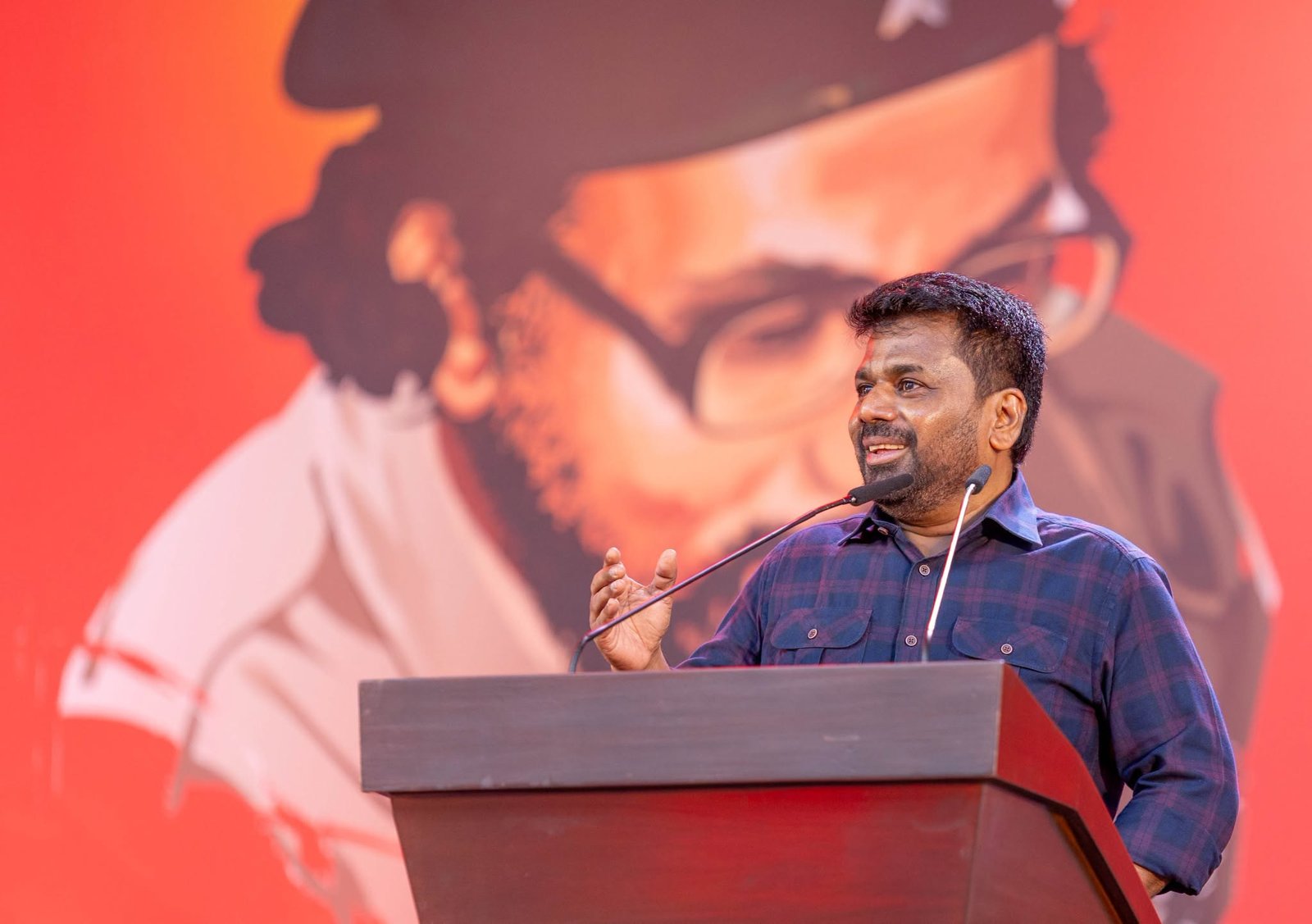
<p>President Anura Kumara Dissanayake stressed that, although the anti-government camp, which has been left weak and helpless, may, because of tension, have its restraint broken and be tempted into improper actions, the present political movement, which has strong experiences in history, would defeat such anarchies and take the country forward.</p>
<p>The president said this while addressing the 37th Ilmaha Heroes’ commemoration. The full speech he made at the gathering, held in remembrance of the party’s founder, Rohana Wijeweera, and other heroes and heroines, is as follows (translated):</p>
<p>61 years of history and distinctive turns</p>
<p>“Thirty-seven years have passed since our comrades, the heroes and heroines including Rohana Wijeweera, the founder of our party, who built our party and showed us for what aim our party should be built, were torn away from us. That is why we are holding this gathering today, with the aim of commemorating their aims, their hopes and the qualities that were in them, and of adding those to our lives.</p>
<p>“Our political movement has now completed a period of nearly 60 years. We know that 59 of those years were a political movement that fought to obtain power. Now, for a period of nearly two years, we are a political movement that has obtained power and is working. There are various stages at various times in our politics: the founding of the party in 1965, the 1971 struggle, our entry into democratic politics again in 1978, the banning of our party in 1983, our re-entry into the democratic stream in 1994, and the capture of power in 2024. In general, our party is a political movement that has taken one of the largest turns a political movement can take.</p>
<p>“Some parties are formed. After a party is formed, it simply disappears. Our party is not like that. Our movement is formed in 1965. In 1971 it faces a massive repression. Many of the people who built and worked in our party are killed, and go to prison camps. In 1978 we come out again. We contest by-elections. We contest Development Council elections. We contest a presidential election. The party is banned again. We have to face challenges in the face of repression. Again, the great heroes of our party, including comrade Rohana and comrade Gamanayake, are killed. We enter politics again. In 2024 we capture power. I think there is no political movement in the world, and certainly none in Sri Lanka, that has faced such a variety of situations.</p>
<p>“How many turns? How many changes? Various forms of challenges. When repression is directed at us, one challenge. When the party is banned, another challenge. When politics is done from inside prisons, another challenge. When governing, another challenge. Within these 61 years our political movement has faced a large amount of diversity both in challenges and in political activity.”</p>
<p>The unchanged aim that has bound the whole history together</p>
<p>“But whatever the conditions that changed, and whatever the nature of the challenges that changed, there is a thread that has knotted this whole history together. There is an interconnection. At the founding of the party, in prison, in the killings of our brothers and sisters, in obtaining power, and after obtaining power, there is a thread, a relationship, that knots this whole history together.</p>
<p>“What is that relationship? Even though, through all these 61 years, the diversity of challenges and the nature of politics all changed, there are several aims that our movement has carried forward without changing. That is what is important. Our movement is built for that aim. The administrations that existed in 1988–89 tore our brothers and sisters away in opposition to that aim. What is that aim, that aim that is not abandoned? It is the aim of creating a very good society for our country and for the people of our country.</p>
<p>“The aim that existed when facing repression in 1965, the aim that existed when contesting elections again, the aim that existed when the party was banned, the aim that existed when this movement again entered the democratic political stream, and the aim that existed even when power was captured — the aim we have protected without abandoning at all these times is the aim of creating a just society for this country and for the people. Through this whole history we have been knotted together by that aim.</p>
<p>“Before 2024 we fight to obtain power for that aim. After 2024 we fight to fulfil that aim. That is the relationship we have not abandoned throughout these 61 years.”</p>
<p>Endurance, collectivity and the bond with the people</p>
<p>“When facing those challenges there was an unconquered courage. There was a quality of not abandoning. Whatever form the challenge came in, at every such time there was the quality of not abandoning. When this political movement was being built, and when our brothers and sisters were being killed, there was the quality of not abandoning. We still have that quality of not abandoning. We possess the quality of fulfilling those aims with unyielding effort.</p>
<p>“In the same way, our party possessed the quality of endurance. In facing repression, the banning of the party, facing slander and untruths, people who were in the movement breaking away and raising slander against the movement, falling below a percentage of 3 per cent, a certain portion of the people being tossed about, and the capture of power — in the face of all this we possessed a great endurance. We still possess, without abandoning it, the quality of endurance for this transformation. If one takes the history of our endurance, what we have now is, in truth, a very smooth one. In truth, there is not much to endure.</p>
<p>“In the same way, we have not abandoned the collectivity that was among us in carrying out this task. We exercise power, we handle power, and we take it towards victory, collectively. We have not abandoned that.</p>
<p>“In the same way, throughout our whole political history there is a close relationship with the people. Listening to the people, working for the people, recognising the rhythm of their lives, and giving them a hearing is important. Any political movement can go forward only with the great bonds that exist between that movement and the people. We have not abandoned that bond.</p>
<p>“We always have a close relationship with the people. In conflict, in prison, and today in exercising government power, the interconnection kept between our movement and the people has been maintained strongly.”</p>
<p>A commemoration not limited to one day, and a new transformation</p>
<p>“The quality of sacrifice, the quality of endurance, the quality of collectivity, the quality of not abandoning, the quality of working for the people — all of those have been bequeathed to us by our past generation. It is that past generation that we commemorate today. If we are commemorating our comrade Rohana Wijeweera, comrade Gamanayake and our leadership bodies, and all our brothers and sisters who worked in the villages, we must carry these qualities forward continuously. If so, this commemoration is not done for a day. We must endure in every moment that passes. In every moment that passes, the interconnection between the people and us must be strengthened. In the same way, as we come together today and discuss, collectivity must be protected in every moment that passes. In the same way, in every moment that passes we must be sacrificial. Our aim must be protected in every moment that passes. We must fight to make that aim victorious. That aim must not only be commemorated; it must always be protected in our lives. If so, this 13 November is not only a day of commemoration. Our aspiration is, by reflecting again and again on the qualities we continuously carry forward, to add the vitality needed for a new transformation. We must be ready for that.”</p>
<p>Ending discoloured politics and creating a clear political division</p>
<p>“Before the 2024 presidential election we saw, on the surface, several camps. There were several candidates. They worked divided. Those who worked divided in 2024 have now had to come together and work. We won the presidential election. Even if they wait until the government falls, no appearance or time of it falling can be seen. In the same way, today the law is reaching everyone, without a distinction of high and low. That is why they are now trying to come together. They now know that this political movement has been victorious; that not even a day can be seen in the future on which it can be brought down; and that the fraudulent and the corrupt will not receive protection either.</p>
<p>“Previously our politics was discoloured. You could not find the government, and you could not find the Opposition. It was discoloured. Why? They mark their ballot for the government; they mark their ballot for whoever wins; and the losing group remains. What does the losing group do? They become ministers in the winning government. You could not find the government, and you could not find the Opposition. People in the villages think: we voted to defeat [them]; two months after voting, the person we defeated has become a minister. The end of that was that a president was made from the person for whom the ballot had been marked in order to defeat him. In 2019 the ballot is marked to chase [him] out; in 2023 he becomes president with that same mark. Not with a new mark. That is how hybrid this is.</p>
<p>“In that period, in politics you could not find the government and you could not find the Opposition. Not only in appearance, but in the work as well. From fraud and corruption you could not find the government and you could not find the Opposition, in the past. When the law was broken, you could not find the government and you could not find the Opposition. Our country’s politics had become discoloured. Today, the government is the government, and the Opposition is the Opposition, exactly.</p>
<p>“For the first time in Sri Lanka, the true essence of the people’s mandate has been protected by the administration. That is important. What happened before was that the essence of the people’s true mandate was distorted in Parliament. The people give their vote for one group to form a government and for another group to form an Opposition. That is the mandate. But in Parliament that mandate is distorted. In governing, that mandate is distorted. In the 2024 presidential election and the general election, the people voted, saying: here is the government, here is the Opposition. Now two years have passed, and there is a government exactly, and an Opposition exactly.”</p>
<p>A picture of two main political currents</p>
<p>“Our country’s politics is moving towards a sharp, clear division. Previously there was no such sharp division. After a long time, a sharp division has arisen in our country’s politics. The two camps called the government and the Opposition have their own distinctive characteristics. The sharp division is not only from the side on which people now sit. The characteristics in these movements make this division still sharper.</p>
<p>“They have been engaged in corruption, and they try to protect themselves from it. We have stopped corruption, and we try to punish the corrupt. The division becomes still sharper.</p>
<p>“They have committed crimes, and this state had become a criminal state. We are changing the criminal state. They are the people who built the criminal state. The division becomes still sharper.</p>
<p>“They create corrupt administrations centred on families. We create administrations while respecting the democratic rights of the public. The division becomes still sharper.</p>
<p>“They make use of racism and religious extremism and do their politics. We stand for national unity and for the rights of citizens. The division becomes sharper.</p>
<p>“They use machines, mantras and charms. We try to build this country on new technology, science and knowledge. The division becomes sharper.</p>
<p>“Therefore, today two main political currents in Sri Lanka have been clearly pictured before the people: the destructive political camp, possessed of old prejudices, that led our country towards destruction, and the new political camp of changing this country. These are the two camps.</p>
<p>“Some media too have divided in the same way. We know that too; there are media institutions that represent that destructive camp. When the division becomes sharp, this is how it is; it divides everywhere in this way. In the same way, I have seen that, including among some members of the clergy, there is at times such a division. The division has become sharp. But this division is simply something like 80 and 20.”</p>
<p>Suppressing anarchy, and responsibility to the people more than to the party</p>
<p>“Where does the continuance of this lie? Preventing anarchies from arising is our responsibility today. Because the government opponents who have been left weak have, by that weakness, been made helpless. That helplessness has put them under tension. The tension has broken their restraint. The collapse of restraint leaves room to do improper things. This is the nature of the camp that is being built against us today. But we know, and we have a firm confidence, that our movement, which has stronger experiences in history than such anarchic, weak struggle movements, will defeat all of that and go forward, protecting this government, this administration and our ideology.</p>
<p>“That is the responsibility assigned to us today. We have today a responsibility different from the responsibility of that earlier time. As I said earlier, if one looks at the history of our party, there were differences in the responsibility and the challenges assigned to us at each stage of history. Building the party, facing the party’s struggles, facing repression, contesting elections, the banning of the party — looking at all of this, our challenges and responsibilities have changed. Even now our challenges and responsibilities are different. Of 60 years, 59 years of challenges and responsibilities were connected with the front of obtaining power. Now, after obtaining power, that must be directed towards fulfilling our aims. Therefore we must come to a mentality and a mode of action able, more than on other days, to think in a new way, to be transformed in a new way, and to overcome new challenges.</p>
<p>“In the past we were more accountable to the party. But in the process of government we are accountable, at the highest level, to the people. In party activity we can resolve problems inside the party. We can talk about shortcomings. We can recognise changes. We can make changes. Why? Our greater responsibility is to the party. But in governing, our full responsibility and bond is towards the people. Therefore, in governing, we must account for every incident that occurs. We cannot hide behind the old thing, the thing that belongs to the past, or the thing the old group did not do. We must be accountable, at this moment, to the people who are here at this moment. The people have given us a mandate. The people have made a government of ours. Then we must be accountable to the people at this moment.</p>
<p>“We have local government institutions, there are chairmen, there are ministers, there are deputy ministers, and there is a state sector connected with them. We must now understand that our accountability is at all times before these people. We must think more than on other days about a behaviour of ours, a statement, or a measure we take. On other days our greater responsibility was to our party. Today our greater responsibility is to the people. Therefore we must be transformed to a place that is bound to the people and accountable to the people. According to the nature of the new responsibility and the nature of the new challenge, we are bound to be accountable to the people.”</p>
<p>A civilised society that questions, instead of fear and submission</p>
<p>“When we are bound to be accountable to the people, the people have a right to criticise us. The people have a right to scold us. The people have a right to protest against us. Why? We are bound to do the people’s work. We must create such a culture. What was our culture before? The people are afraid of the ruler. The people are submissive to the ruler. The people are the slaves of the ruler. This is how our history was. The people of the village are afraid of the chairman of the Pradeshiya Sabha. Those around are afraid of the Pradeshiya Sabha member. The people of the province are afraid of the minister. The people of the country are afraid of the leader. This is how our bond of accountability was. Fear and submission are the relationship between the ruler and the people. This is the nature of the relationship that existed for a long time in our country between the people and the ruler. We must break this relationship.</p>
<p>“What is the new relationship? The people have a right to question the ruler. They have a right to criticise. The people have a right to protest against the ruler. We have the desire to create a new transformation, a new relationship between the ruler and the people. Some people are not used to building that relationship. There is a group. They have become used to living in fear. They are used to living in submission. Therefore, when a relationship between the people and the ruler is made in this way, they cannot understand that freedom, that new relationship.</p>
<p>“When they cannot understand it, they go to another level of making light of it. Do not take those things into account. They have no validity at all. The words of a scolding nature begin to change. The tones of scolding begin to change. The existing civility is broken down. Why? That group had become used to living in fear, to living in submission. They are not used to a society that questions the ruler. They have become used to the old habit. What is the old habit? A habit of remaining submissive to the ruler, a habit of remaining afraid of the ruler. None of us is prepared to frighten anyone or to subjugate anyone. Our hope is a people who question the ruler. A people who criticise the ruler. When we go to build that, there is a civility in it. There is a frame. One must remain inside that box. But the critic has become unable, at the very least, to protect the box of his own civility. We will not, however, be agitated. All criticisms that are not presented inside the frame of that civility are rejected by the people of the country. Some people talk to us and ask why, comrade, we allow [them] to scold in that way. Let them scold as much as they like. Those are not things that a civilised society accepts or approves.</p>
<p>“It is such a transformation that we need between the ruler and the people. We need a new transformation of our economy. We need a new transformation of our politics. We have begun the journey needed for that transformation. Therefore the journey that we, for a period of more than 61 years, through a number of our generations, came on collectively, enduring and making sacrifices for one and the same aim, we have today transformed to the place of capturing power. I stop by inviting all of us to come together in order to gather the challenges that have been faced in this capture of power, and the new things, and to go forward. Thank you very much. May all of you be victorious!”</p>
<p>Translated from the LSN Sinhala edition.</p>