Politics · India Bureau
Webb and Hubble reveal ancient merger secrets in Black Eye Galaxy
New observations of M64, located 17 million light-years away, show evidence of a galactic collision dating back over a billion years. The distinctive counter-rotating gas bands visible in the galaxy appear to be remnants of a merger with a smaller satellite galaxy.
LSN India ·
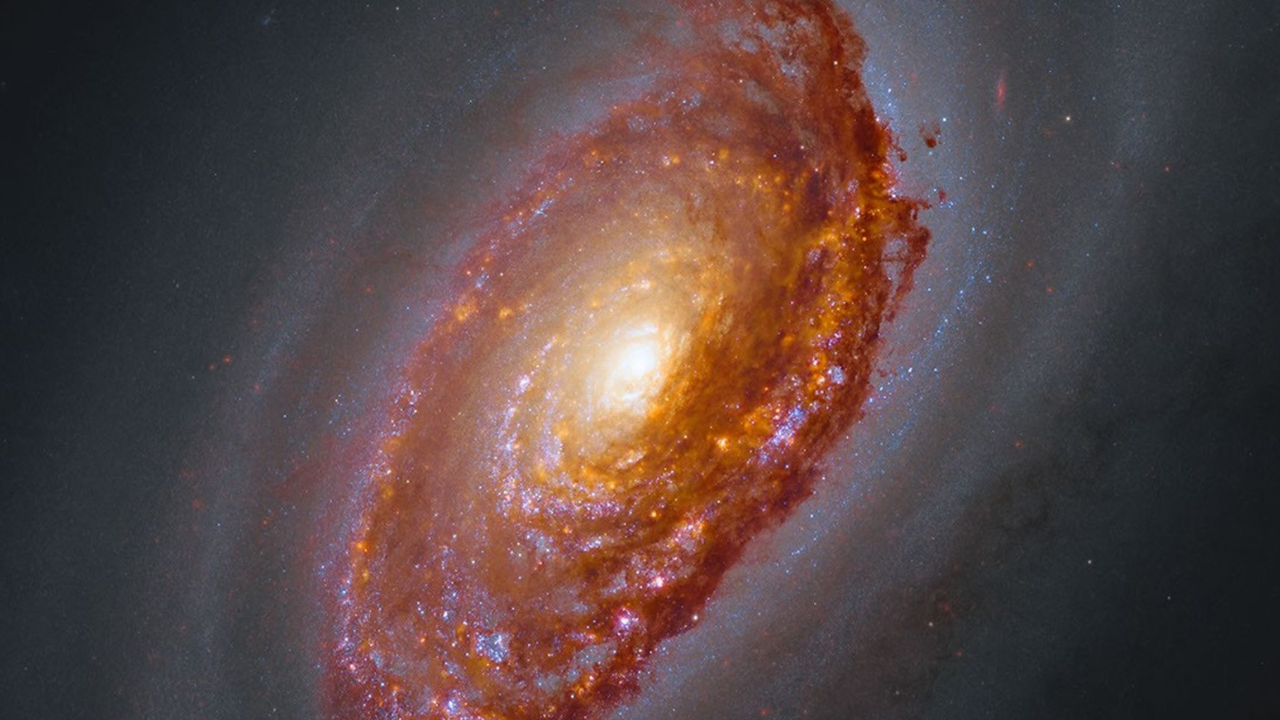
The Black Eye Galaxy, officially known as M64 and located in the constellation Coma Berenices, has long puzzled astronomers with its unusual internal dynamics. Unlike most galaxies where gas and stellar material rotate uniformly, M64 exhibits a remarkable counter-rotation—gas in its outer regions moves in the opposite direction to the gas and stars in its inner regions.
Combined observations from the James Webb Space Telescope and the Hubble Space Telescope have provided fresh insights into this astronomical peculiarity. The new imaging reveals a dusty star-forming band that traces the boundaries between these opposing rotational zones, offering visual evidence of the galaxy's tumultuous past.
According to NASA analysis, the counter-rotating pattern is likely a remnant of a significant merger event between M64 and a smaller satellite galaxy more than a billion years ago. When the smaller galaxy collided with M64, its orbital motion imposed a different rotational direction on the outer gas, creating the distinctive pattern observed today.
The discovery underscores how galactic mergers leave lasting imprints on stellar systems, reshaping their structure and dynamics over cosmic timescales. The enhanced clarity from the Webb and Hubble observations allows astronomers to better understand how such collisions influence star formation and the long-term evolution of galaxies.