World · India Bureau
Webb Telescope Spots Three Supermassive Black Holes in Ancient Galaxy
The James Webb Space Telescope has made a remarkable discovery, identifying three supermassive black holes within a single ancient galaxy, offering unprecedented insights into the early universe's structure and evolution.
LSN India ·
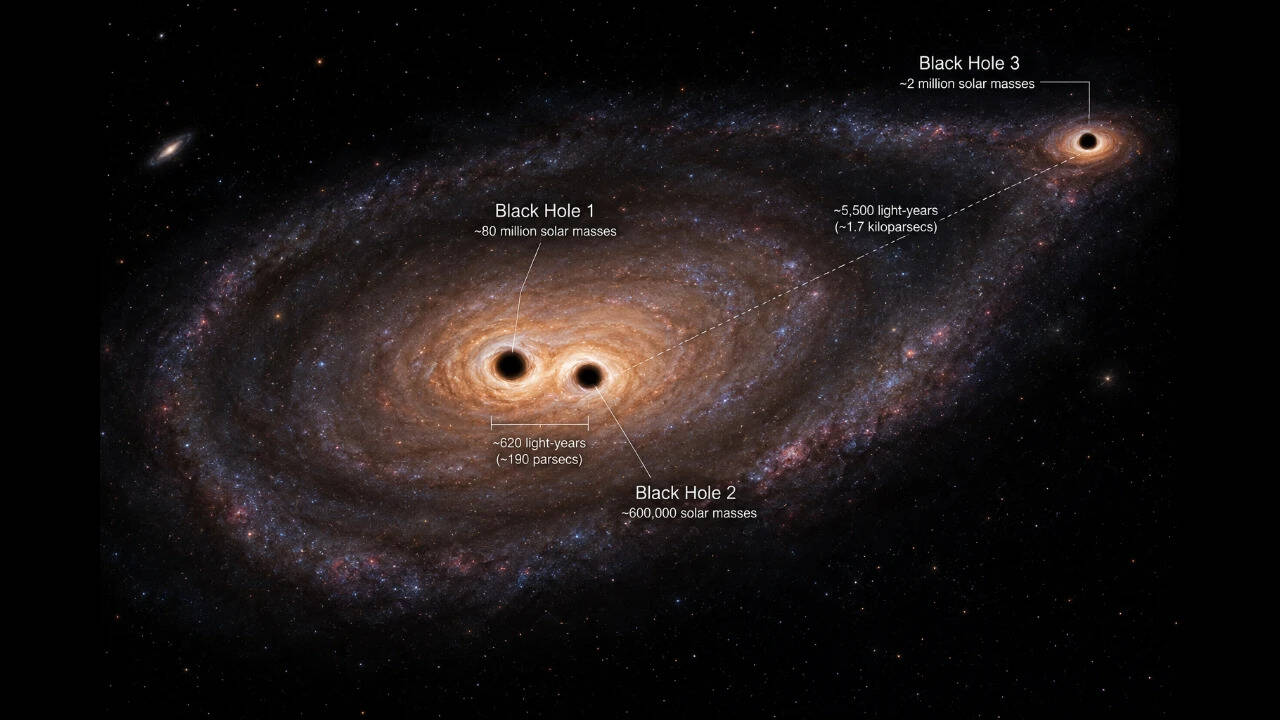
Astronomers using the James Webb Space Telescope have detected three supermassive black holes coexisting within the same distant galaxy, marking a significant breakthrough in understanding the cosmos's formative epochs. The discovery challenges existing models of how supermassive black holes develop and interact within galactic systems, particularly in the universe's early phases.
The galaxy in question dates back to the ancient universe, making this finding particularly valuable for astrophysicists studying the formation and growth mechanisms of supermassive black holes. The presence of multiple black holes suggests complex gravitational dynamics and galactic merger events that shaped early cosmic structures.
The James Webb Space Telescope's advanced infrared imaging capabilities enabled astronomers to detect and analyze these previously hidden objects with unprecedented clarity. The instrument's sensitivity to distant radiation has revolutionized observations of the early universe, revealing cosmic phenomena that were invisible to previous generations of telescopes.
This discovery adds to the growing body of evidence suggesting that supermassive black holes played a crucial role in galaxy formation during the universe's youth. Researchers indicate that further analysis of similar systems could yield critical information about the relationship between black hole growth and galactic evolution in the cosmos's earliest billions of years.